








News

Share
Published 16:14 14 Jun 2024 BST
Updated 16:18 14 Jun 2024 BST
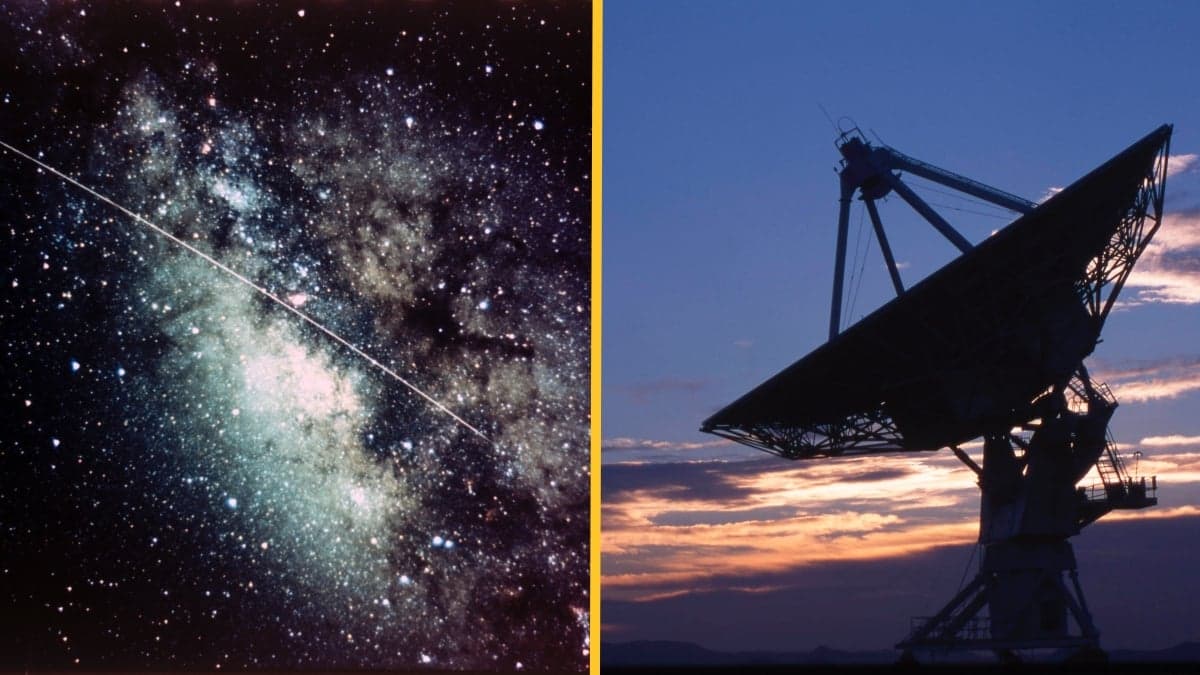
Research into unexplained and mysterious radio signals from space have led scientists to wonder if they could be coming from a galaxy similar to our own.
A team of scientists from University of Toronto's Dunlap Institute for Astronomy & Astrophysics examined almost 130 non-repeating FRB's, which are very intense, very short blasts of radio energy that come to us from deep in space.
They release as much energy in a milisecond as the Sun does in three days, and were first discovered in 2007.
Since then, more than 1,000 FRB's have been detected from various parts of the universe, and most leading scientists still do not know where they come from.
The new report, which was published in The Astrophysical Journal, suggests that these sounds come from galaxies like our own Milky Way, with only relatively limited densities and modest magnetic fields.
The study looked at the sources using polarised light, meaning that the the scientists were able to examine not just how bright they were but also what angle the vibrating electromagnetic waves came at.
"This was the first look at the other 97 per cent," said lead author of the study Ayush Pandhi. "It allows us to reconsider what we think FRB's are and see how repeating and non-repeating FRB's may be different."
Polarized light is made up of waves that vibrate in a single plane—vertically, horizontally, or another angle in between.
The direction that light from FRB's is polarized was seen to change in two ways: with time and with the colour of the light. These changes can explain how an FRB might have been produced and what kind of material it passes through on its journey to Earth.
"This is a new way to analyze the data we have on FRB's," Pandhi added. "Instead of just looking at how bright something is, we’re also looking at the angle of the light’s vibrating electromagnetic waves.
"It gives you additional information about how and where that light is produced, and what it has passed through on its journey to us over many millions of light years."
The study concluded that most FRB's are not like the few repeating sources that have been previously studied. It suggests that this sample is either a separate population or more evolved versions of the same population that originate in a less extreme environment with a lower burst rate.
Back in 2022, scientists discovered that an FRB signal from space came from a collection of seven galaxies, around eight billion light-years away.
That was the most powerful FRB that has ever been picked up, and scientists believed that the energy blasts were caused by the group of galaxies interacting with each other and potentially merging.
Related Links:

News

News

News

News
Loch Lomond crash: boy, 16, and man, 80, killed in light aircraft crash near Drymen
Major incident declared after fatal plane crash Two people have died following a light aircraft crash in Stirlingshire, prompting a major emergency response and an investigation into the circumstances surrounding the incident. The victims were a 16-year-old boy and an 80-year-old man, who were both found dead after the aircraft came down near Drymen on […]
News
2 days ago
White House press secretary Katie Zacharia fired after five days in position
It comes after Trump said she should ‘reconsider’ her job White House press secretary Katie Zacharia has been fired after five days in the position, as per reports. Zacharia had a tough start to life in the role, hosting a briefing on Tuesday which caused a lot of criticism and raised a number of questions. […]
News
2 days ago
Piers Morgan urges Trump to side with Ukraine against ‘modern-day Hitler’ Putin
News