









News

Share
Published 13:46 4 Apr 2026 BST
Updated 13:47 4 Apr 2026 BST

NASA has launched humankind further than ever before into space with the launch of Artemis II.
On Wednesday, 1 April, the mission successfully took off with the crew now bound for the Moon.
The 10-day mission will send four astronauts around the Moon in the Orion spacecraft to test life-support systems, navigation, and deep-space maneuverability before future lunar landings.
The four astronauts on humanity's furthest ever journey into space are NASA's Reid Wiseman, Victor Glover and Christina Koch, and Jeremy Hansen of the Canadian Space Agency.
The crew have sent some images back from their history-making trip, but one photo has lots of people down on Earth all saying the same thing.
Wiseman, who is Commander of Artemis II, took a dazzling image of our planet, and released it via NASA.
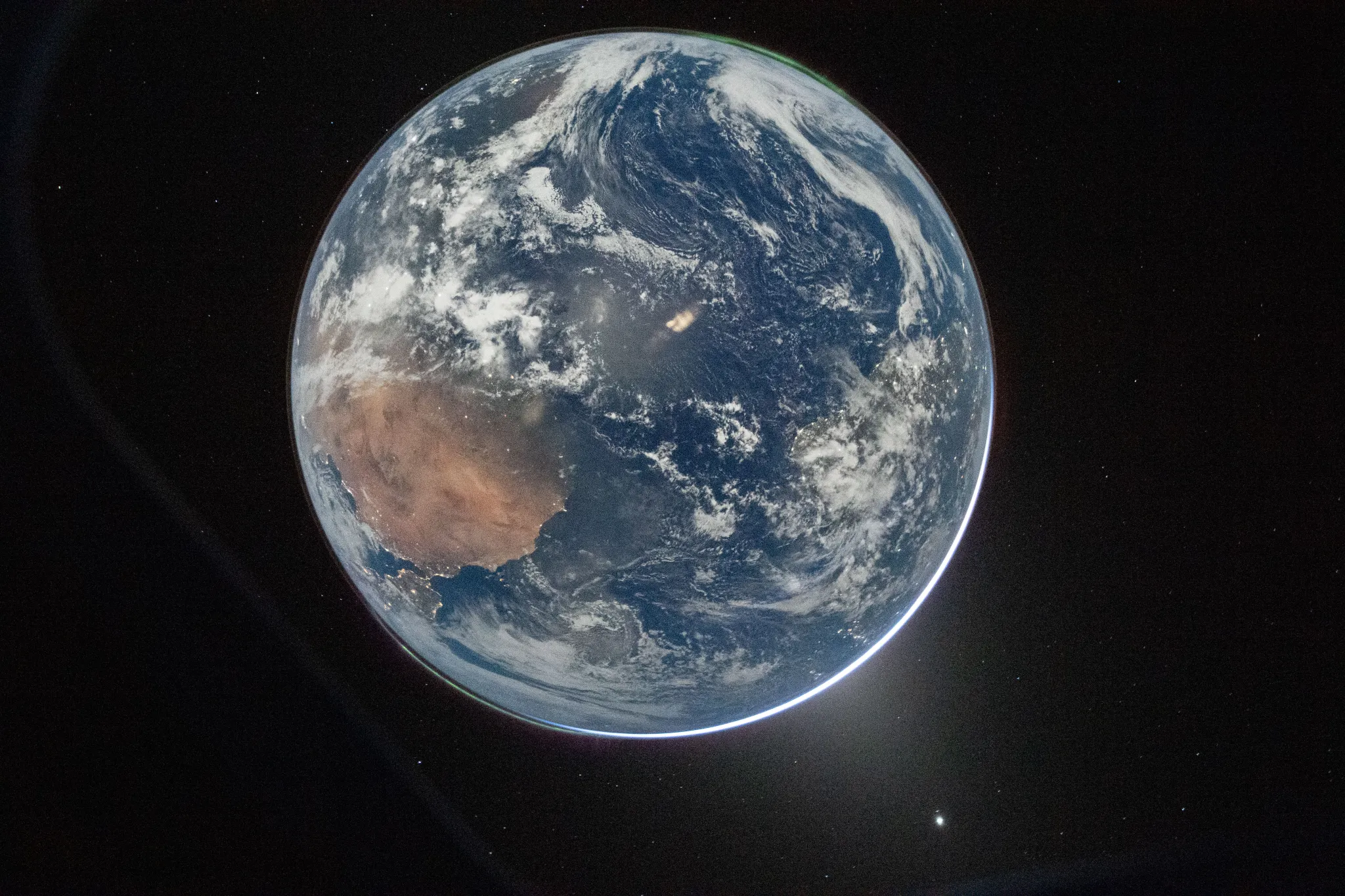
The image, titled 'Hello, World', was taken from the window of the spacecraft after they completed the translunar injection burn.
"There are two auroras (top right and bottom left) and zodiacal light (bottom right) is visible as the Earth eclipses the Sun," NASA said.
However, the space agency made the mistake of comparing the new image with a picture from Apollo 17's mission in 1972, and the internet has a lot to say about it.
"We’ve come so far in the last 54 years, but one thing hasn’t changed: Our home looks gorgeous from space! The left view is from the Apollo 17 crew in 1972 and the right was captured yesterday by the Artemis II crew," NASA wrote.
People have responded to the tweet by pointing out how dull the 2026 image looks compared to the one from 1972.
"The old Earth image looks sharper while this new image looks dull," one person wrote. "Camera quality or climate change?"
Another penned: "Why does the one from 72 looks better?"
"What are we doing so wrong . The earth looks pale. We are losing it," a third put.
However, other users on social media offered an explanation for the stark difference in colourings on the images.
"What you're looking at is actually the night side of earth, opposite the sun. It looks grainy because the image is hyper exposed for visibility," one user explained.
Another offered: "The side of the Earth photographed in 2026 appears to be in nighttime. Hence the arc of brightness at the bottom right."
While a third added an explanation about the difference in cameras: ""Earth didn’t change - how we capture it did. The colour difference between the 1972 “Blue Marble” and modern Earth images comes down to technology.
"Apollo 17 used film cameras, which naturally boosted colour and contrast. Today, digital sensors, atmospheric correction, and colour calibration are used.
"Most modern images are also composites, not single shots. That’s why today’s Earth can look less 'vivid'."
Explore more on these topics:

News

News

News

News
Piers Morgan urges Trump to side with Ukraine against ‘modern-day Hitler’ Putin
‘Give this guy the support he needs to defeat the modern-day Hitler.’ Piers Morgan has urged Donald Trump to side with Ukraine and Volodymyr Zelensky in their war against Russia. There have been strained tensions this week between Ukraine and the US as Trump has cosied up to Vladimir Putin with diesel deals and sham […]
News
2 days ago
Execution of mass killer will not be livestreamed, Trump says
The US president has done a U-turn The execution of a Nidal Malik Hasan will no longer be livestreamed, US President Donald Trump has said. Last week, it was announced that the execution of Hasan, the man behind the Fort Hood shooting, would be livestreamed. The shooting, which happened in Texas in 2009, killed 13 […]
News
2 days ago
Royal Mail ‘on brink of collapse’ as 400 workers reportedly quit every week
News