







News

Share
Published 10:38 27 May 2018 BST
Updated 10:49 27 May 2018 BST
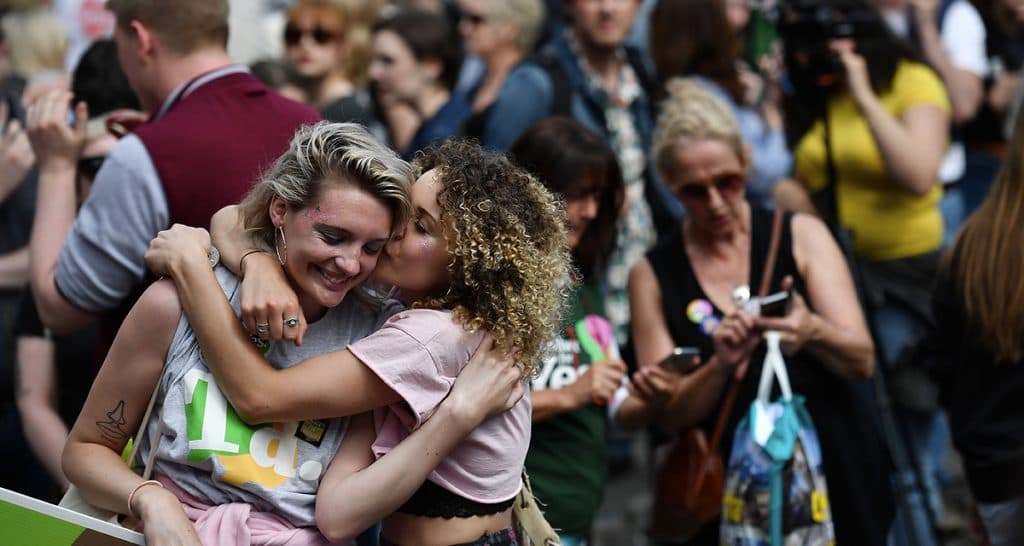
 (Credit: Jeff J Mitchell)[/caption]
This has been the Irish solution, banning a form of healthcare seen as a human right by the World Health Organisation and the United Nations.
Irish voters have put a stop to the practice.
The only way to change the constitution in Ireland, which is far more powerful than an average piece of legislation created by government, is with a referendum. Before Friday, no one under the age of 53 in Ireland ever had a chance to vote on legalising abortion. But now they have, the constitutional ban is lifted and Irish women will no longer have to travel for abortion services.
https://www.youtube.com/watch?v=gIOax5hTIuw&t=3s
(Credit: Jeff J Mitchell)[/caption]
This has been the Irish solution, banning a form of healthcare seen as a human right by the World Health Organisation and the United Nations.
Irish voters have put a stop to the practice.
The only way to change the constitution in Ireland, which is far more powerful than an average piece of legislation created by government, is with a referendum. Before Friday, no one under the age of 53 in Ireland ever had a chance to vote on legalising abortion. But now they have, the constitutional ban is lifted and Irish women will no longer have to travel for abortion services.
https://www.youtube.com/watch?v=gIOax5hTIuw&t=3s
It's a long trip from London to Dublin. Expensive flights push travellers to the Rail & Sail, a combined train and ferry ticket which costs £45 one way but takes eight hours. One route to an abortion in the UK, it's also how some Irish people returned home to vote in the referendum.
From a metropolitan hub to another via Milton Keynes, Crewe, Rhyll and all the countryside in between. There may as well be a mirror in the ink black Irish sea, such is the trueness of the referendum reflection to our Brexit schism - young versus old, rural versus urban.
[caption id="attachment_180888" align="alignnone" width="4675"] (Credit: Jeff J Mitchell)[/caption]
The boat carries mixed freight through the crude oil. Old fat men side eye young women sporting proud 'Tá' badges - Irish for yes, or as close to it as Gaeilge grammar allows.
Emma O'Reilly is one such proud young woman. She woke up at 5am in Norwich to cast her vote 16 hours away in Galway. "That could be me," she says. "That could be me if I choose to have a child in Ireland."
Dublin streets are littered with signage, 20 ft high, from both sides. Pictures of foetuses abound. The signs are split half and half Yes/No, but the people underneath them are nearly universally pinned with badges saying Yes. London painted a similar picture when David Cameron turned his hand to reducing politics to binary answers.
[caption id="attachment_180889" align="alignnone" width="3000"]
(Credit: Jeff J Mitchell)[/caption]
The boat carries mixed freight through the crude oil. Old fat men side eye young women sporting proud 'Tá' badges - Irish for yes, or as close to it as Gaeilge grammar allows.
Emma O'Reilly is one such proud young woman. She woke up at 5am in Norwich to cast her vote 16 hours away in Galway. "That could be me," she says. "That could be me if I choose to have a child in Ireland."
Dublin streets are littered with signage, 20 ft high, from both sides. Pictures of foetuses abound. The signs are split half and half Yes/No, but the people underneath them are nearly universally pinned with badges saying Yes. London painted a similar picture when David Cameron turned his hand to reducing politics to binary answers.
[caption id="attachment_180889" align="alignnone" width="3000"] (Credit: Charles McQuillan)[/caption]
Campaigners told JOE they feared a silent 'No' vote and I saw it. On polling day the city's main drag was picketed by two young American girls and a large red banner painted with the words 'Repeal kills vote No.' Largely they were alone at the base of Dublin's Spire, outside the General post Office, but the isolation was broken when a passing bus driver softly bipped his horn and lifted a thumb from the steering wheel. Present but not signifiant enough to impact the result, clearly. In Dublin the repeal vote was over 75 per cent.
Just before the result was called out to the gathered crowd at Dublin Castle a short heavy burst of rain fell. No one seemed to notice, they were waiting for a different deluge. One Yes campaigner, Beth, yawned between sobs. Years of late nights and graft manifest.
"We all worked so hard for it, and here it is," Beth said. We had spoken on polling day, next to the No campaigners by the Spire.
She was different to that nervous but positive woman handing out stickers, waiting for an exit poll. Now she was jubilant. At the end of our conversation a man approached her with a copy of the constitution, open on Article 40.3.3. "Here's a copy of the Eighth Amendment, I'd like you to help me erase it," he said.
https://twitter.com/PoliticsJOE_UK/status/1000376145295101953
My taxi on the way back to the airport was sedated. Drive was busy. Leinster had just kicked off against Scarlets in the Pro14 final. He didn't mention the referendum other than a march happening in town. At the terminal I said thank you and noticed an A4-sized No sticker resting on the parcel shelf, ripped from the rear windscreen.
Ireland's referendum has been won but the legislative processes haven't started. And nuanced questions need answers that cannot come from only one of the sides in the discussion.
(Credit: Charles McQuillan)[/caption]
Campaigners told JOE they feared a silent 'No' vote and I saw it. On polling day the city's main drag was picketed by two young American girls and a large red banner painted with the words 'Repeal kills vote No.' Largely they were alone at the base of Dublin's Spire, outside the General post Office, but the isolation was broken when a passing bus driver softly bipped his horn and lifted a thumb from the steering wheel. Present but not signifiant enough to impact the result, clearly. In Dublin the repeal vote was over 75 per cent.
Just before the result was called out to the gathered crowd at Dublin Castle a short heavy burst of rain fell. No one seemed to notice, they were waiting for a different deluge. One Yes campaigner, Beth, yawned between sobs. Years of late nights and graft manifest.
"We all worked so hard for it, and here it is," Beth said. We had spoken on polling day, next to the No campaigners by the Spire.
She was different to that nervous but positive woman handing out stickers, waiting for an exit poll. Now she was jubilant. At the end of our conversation a man approached her with a copy of the constitution, open on Article 40.3.3. "Here's a copy of the Eighth Amendment, I'd like you to help me erase it," he said.
https://twitter.com/PoliticsJOE_UK/status/1000376145295101953
My taxi on the way back to the airport was sedated. Drive was busy. Leinster had just kicked off against Scarlets in the Pro14 final. He didn't mention the referendum other than a march happening in town. At the terminal I said thank you and noticed an A4-sized No sticker resting on the parcel shelf, ripped from the rear windscreen.
Ireland's referendum has been won but the legislative processes haven't started. And nuanced questions need answers that cannot come from only one of the sides in the discussion.Explore more on these topics:
News

News
News
News
Virgin Atlantic flight declares midair emergency over UK minutes after take off
The plane squawked 7700 A Virgin Altantic flight has declared a midair emergency over the UK minutes after taking off. The A330 aircraft, registered G-VSXY, departed Manchester Airport at 15:10 with New York as its destination. The flight did multiple loops in the Merseyside area, to the west of Manchester, before landing back at the […]
News
4h
81-year-old woman spends £50,000 in battle with council to walk through her own back garden
Derbyshire resident won costly legal battle over garden gate Helene Ball, 81, has just come out victorious of a costly legal battle against Derbyshire County Council over garden gate access rights, in her own garden, setting her back £50,000 in the process. The 81 year-old resident is celebrating her victory over the council after three […]
News
6h
RNLI station forced to close due to anti-migrant protestors
News