








News

Share
Published 14:47 19 Dec 2023 GMT
Updated 11:21 7 Feb 2024 GMT
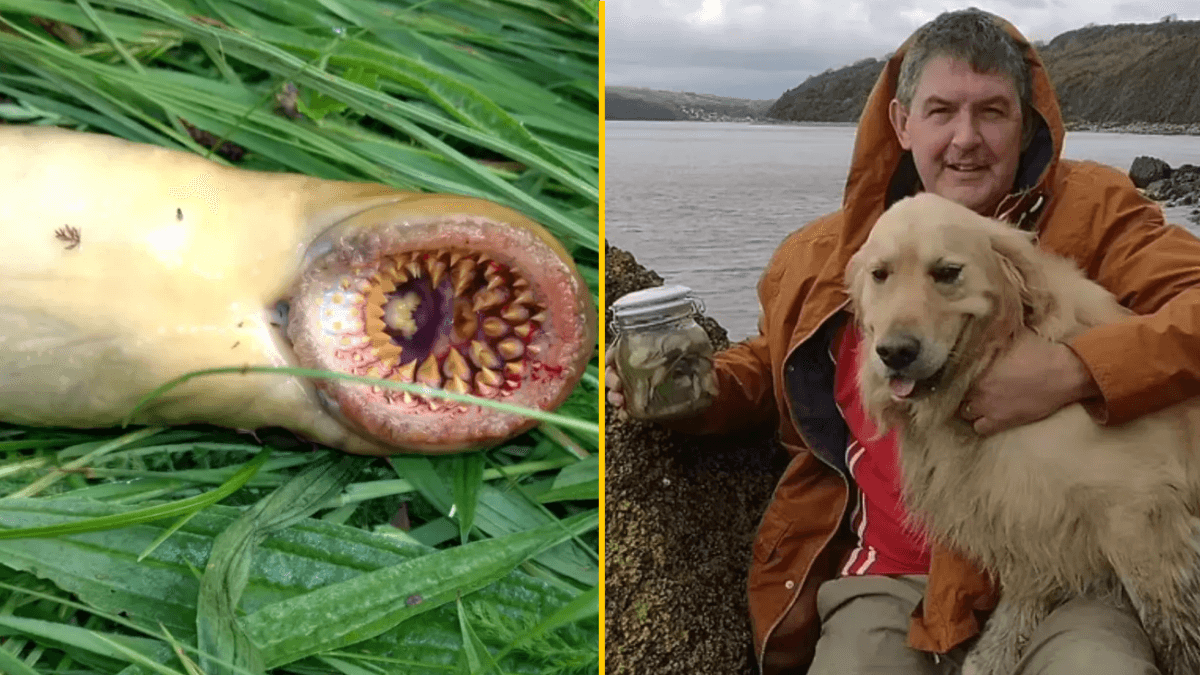
They look like they're straight out of a horror movie, with a hole for a face, and rows of teeth for features.
Spawning in freshwater they feed on tiny algae and microorganisms, then move on to the sea where they attach their mouth to the side of fish and suck the life out of them. They then migrate back into freshwater to spawn, after which they die.
Craig Evans found one of these "wonders of nature", a sea lamprey, while fishing for trout in a West Wales river and some people will now never sleep again.
The sea lamprey, petromyzon marinus, is the largest of the three lamprey species in the UK. It has an eel-like body and a jawless mouth, round, and sucker-like, with sharp teeth arranged in concentric, circular rows. Adults can reach up to 120cm in length and weigh as much as 2.3kg. Lamprey fossils have been found in the late Silurian and Devonian periods, approximately 450 million years ago.
While most people would be terrified to see a lamprey, dead or alive, Evans, a coastal forager, felt "fortunate" to find one. It was dead.
In an Instagram post, he explained: "These wonders of nature spawn in freshwater, feed on tiny algae and microorganisms until they migrate to sea to prey on larger fish.
"Its fearsome mouth attaches itself to the side of the fish and sucks it blood etc. This one was around 2ft in length and weighed around a Kilo. I was fortunate enough to stand over a number of these spawning in fast-flowing water about a foot deep. After spawning in June they all die. I've seen many of these over the years and the only mammal that eats them are otters and then only last few inches of its tail."
Craig added that the presence of the sea lamprey is "a sign of a healthy ecosystem."
The sea lamprey has an eel-like body without paired fins. Its mouth is jawless, round and sucker-like, and as wide or wider than the head; sharp teeth are arranged in many concentric circular rows. There are seven branchial or gill-like openings behind the eye. Sea lampreys are olive or brown-yellow on the dorsal and lateral part of the body, with some black marblings, with lighter coloration on the belly. Adults can reach a length of up to 120 cm (47 in) and a body weight up to 2.3 kg
When asked if they could attach themselves to humans, Craig told one follower that it could happen but he "had never heard of it," which is probably not the answer everyone wants to hear.
Commenters on the post were horrified to learn of the creature.
One wrote: "That is the stuff of nightmares for me!" Another added: "That’s my nightmares sorted for tonight then."
Another commented added: "That is a beast! I didn’t know these existed here! Incredible!" While someone else added: "What in the devilish nightmare of hell is this!?! Arrrrghhh"
"Reminds me of the film… Teeth." Sweet dreams, lads," another commenter added.
The sea lamprey is listed on the International Union for Conservation of Nature (IUCN) Red List of Threatened Species, so chances are most people may never see one.
Read more:

News

News

News

News
Loch Lomond crash: boy, 16, and man, 80, killed in light aircraft crash near Drymen
Major incident declared after fatal plane crash Two people have died following a light aircraft crash in Stirlingshire, prompting a major emergency response and an investigation into the circumstances surrounding the incident. The victims were a 16-year-old boy and an 80-year-old man, who were both found dead after the aircraft came down near Drymen on […]
News
19h
White House press secretary Katie Zacharia fired after five days in position
It comes after Trump said she should ‘reconsider’ her job White House press secretary Katie Zacharia has been fired after five days in the position, as per reports. Zacharia had a tough start to life in the role, hosting a briefing on Tuesday which caused a lot of criticism and raised a number of questions. […]
News
1 day ago
Piers Morgan urges Trump to side with Ukraine against ‘modern-day Hitler’ Putin
News