








Science

Share
Published 08:12 19 Feb 2025 GMT
Updated 08:12 19 Feb 2025 GMT
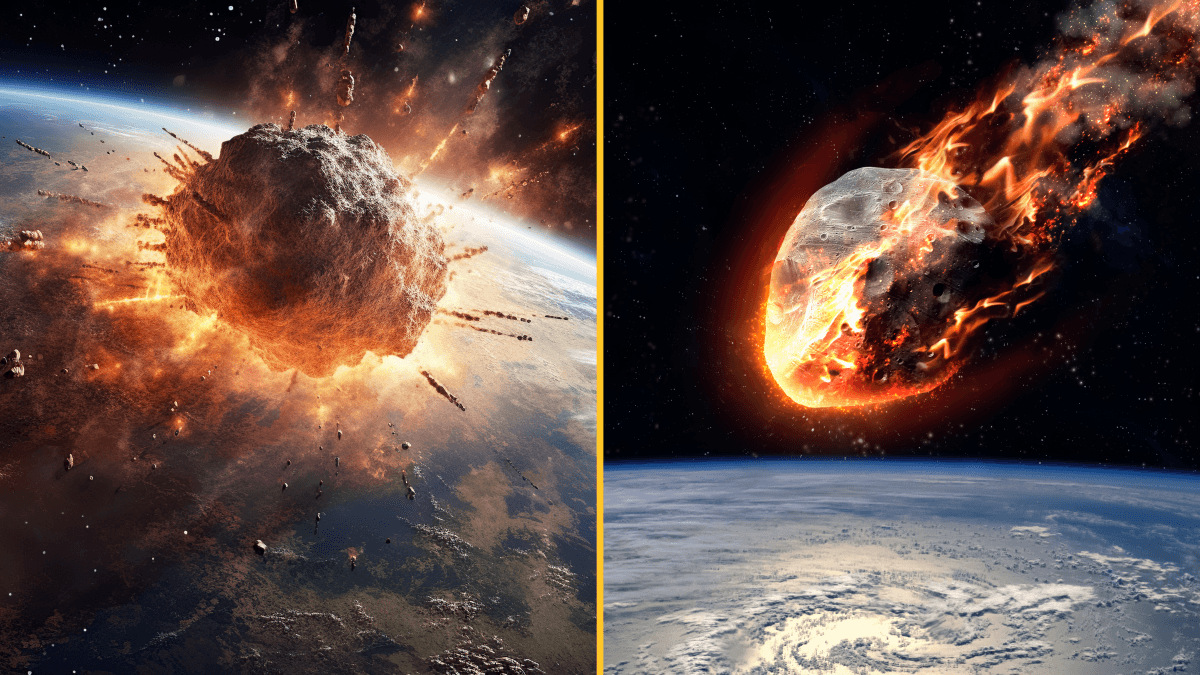
NASA have confirmed that the odds of the 'city killer' asteroid 2024 YR4 hitting Earth have increased once again.
The asteroid, which is believed to be around the size of Big Ben, had a one in 43 (2.3 per cent) chance of hitting Earth in 2032.
This had previously been revised from a one in 53 chance (1.33 per cent).
However, the latest update from the space agency is that the likelihood of the asteroid hitting our planet is now one in 38 (2.6 per cent).
It comes after NASA revealed a list of possible countries that could be hit by the asteroid in 2032.
David Rankin, a scientist at NASA's Catalina Sky Survey Project, has projected a 'risk corridor' for the asteroid that shows the large stretch of Earth that could be hit.
Rankin's 'risk corridor' stretches from South America across the Pacific Ocean, across south Asia, the Arabian Sea and Africa.
Specific countries that may be impacted include Venezuela, Colombia, Ecuador, India, Pakistan, Bangladesh, Ethiopia, Sudan and Nigeria.
A precise location can not be identified as it would depend on the rotation of the Earth at the moment of impact.
Meanwhile, an international team are using the James Webb Space Telescope to determine how much damage the asteroid could do.
In 1908, Siberia was hit by the Tunguska asteroid which was also a similar size and it destroyed 830 square miles of forest.
2024 YR4 was first discovered in December 2024 by the Asteroid Terrestial-impact Last Alert System station in Chile, funded by NASA.
It is estimated that the asteroid could flatten structures for up to two miles in any direction from the impact size, however the size estimates could be incorrect.
Determining the size of an asteroid involves looking at it through a powerful telescope, and figuring out the size through the brightness of the light reflected from its surface.
A spokesperson from the European Space Agency said, to the Daily Mail: "Astronomers around the world are using powerful telescopes to measure the asteroid’s orbit as accurately as possible. But knowing its orbit will only tell us the asteroid could impact Earth, not how significant an impact could be.
"It is very important that we improve our size estimate for 2024 YR4: the hazard represented by a 40 m asteroid is very different from that of a 90 m asteroid."
It is hoped the James Webb Space Telescope will solve this problem, as it uses infrared sensors to look at the heat radiating off the asteroid, giving them a more accurate estimate of size.

Science
Science

Science

Science
Supercomputer predicts exactly when humans will become extinct
That doesn’t sound good A supercomputer has predicted when humans will become extinct. Though climate change is always in the news and becoming a priority for governments to tackle, its long term impacts could be devastating not just on the environment but on our species as well. With this in mind, a supercomputer has analysed […]
Science
9 months ago
You need to ejaculate this many times in a month to prevent prostate cancer, experts say
Bashing the bishop is a scientifically proven way of staying healthy Regular ejaculation is something of a cheat code when it comes to shielding yourself from cancer. In a study published by European Urology, which followed 32,000 men for 18 years, scientists discovered the magic number of 21 times per month will reduce the chances […]
Science
9 months ago
Science
The world could end in 25 years, says Oxford scientist
Science