








News

Share
Published 10:34 27 Aug 2026 BST
Updated 09:35 28 Aug 2026 BST
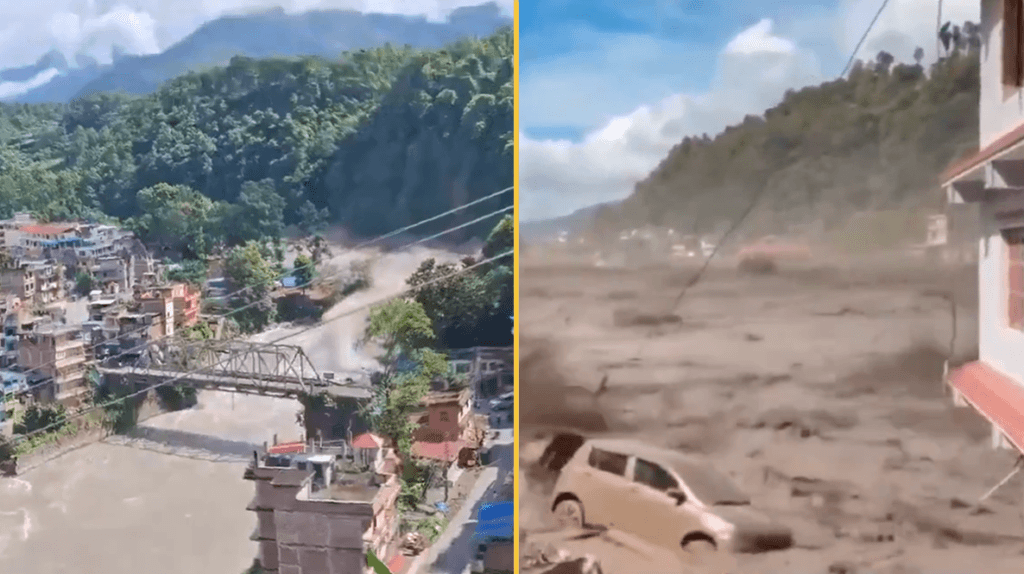
Scores of people have been killed and more than 1,000 are missing following the flash floods which on Wednesday swept through the Nepal-Tibet border region.
It was a landslide of ice and rock which is resulted in a torrent of mud, water and debris bursting the banks of the Trishuli river, also known as the Bhotekoshi, which runs between China and Nepal.
Swept away on Wednesday morning local time were even homes, roads, bridges and power plants, The Guardian reports.
As per authorities in Nepal, reported missing are 403 people, including 341 from foreign countries including India, the US, the UK, Australia, South Korea and Malaysia.
At least thirty-three people from the UK are among hundreds which are feared missing, and among the still unaccounted for are also two Irish nationals.
According to the experts at the Kathmandu-based International Centre for Integrated Mountain Development, in just half an hour the water levels on the Trishuli river rose by as much as nine meters.
Most affected, the experts said, were the Lhende Khola river, a tributary of the Bhotekosh.
What is thought to be the likely cause of the flash flooding is an avalanche from a glacier, The Guardian writes.
On Wednesday, as reported by local media, Nepal’s foreign minister, Shisir Khanal, told the country’s parliament that initial reports suggested the floods could have been caused by an earthquake in the area that triggered a landslide.
But while the event was initially reported to be caused by a magnitude 4.4 earthquake, the US Geological Survey (USGS) said that further analysis showed the “seismic event was a glacial collapse and debris flow that caused subsequent catastrophic impacts downstream” and “no earthquake had occurred”.
According to the USGS, the glacial collapse had registered as a magnitude 5.2 seismic event on the Richter scale.
This seismic event occurred near the border between Nepal and China at 8.37am local time on Wednesday.
A geomorphologist at the University of Calgary in Canada, Assoc Prof Daniel Shugar, said that initial satellite analysis showed a 0.2 sq km chunk of ice “collapsed about 1.2km vertically”.
“What I can see in … satellite imagery from Planet Labs, the lower part of a glacier broke off at about 5,200 metres and crashed onto the valley floor about 1,200 metres below,” he wrote on Bluesky.
He added that the satellite imagery also seemed to show that a large amount of snow had melted in the 24 hours prior to the disaster.
“Some of the glaciers in the valley were covered in snow yesterday and today they are mostly bare ice. So in other words (and I haven’t seen any weather station data yet), it was probably warm”, he added, highlighting that construction could also be a factor.
On the other hand, Prof Andrew Mackintosh, a glaciologist at Monash University in Melbourne, said it was unclear whether the collapse was isolated to the glacier, or was the “whole mountainside collapsing that included part of the glacier”.
“When a glacier of that scale collapses, it generates a lot of water, and then there’s a cascading sequence of events … where the water and the sediment combine and bulks up and creates the flood.”
While a glacial collapse was “certainly involved”, it was “unlikely to be the sole cause”, an international group of glacier researchers added.
Meanwhile, Mackintosh said that while “it’s hard as a glaciologist not be alarmed by these events that seem different to what we’ve observed previously, there have been so few of these documented that we’re not really able to make very clear statements about the specific relationship between glacier collapse and climate change yet”.
However, scientists do in fact “have very high confidence” in the relationship between glacier retreat and climate change.
The Himalayas, which span Nepal, India, China, Bhutan, and Pakistan, are warming twice as fast as the global average.
This factor puts the region at increased risk of avalanches, landslides and floods.
In 2023, the United Nations said that Nepal’s mountains had lost close to one-third of their ice in just over 30 years due to global warming.
Explore more on these topics:

News

News

News

News
Archie Goodburn meets prime minister over cancer funding
‘Give us a chance to fight’ Archie Goodburn is due to meet the prime minister today after his emotional plea for better brain cancer care and more research funding prompted a response from Downing Street. The Scottish swimmer made the appeal during an appearance on BBC Breakfast in August, calling on the government to appoint […]
News
just now
Andy Burnham rules out deal with Greens over ‘Zionism is racism’ motion
“We can’t support a partnership with a party that holds a position that has recently been adopted.” Andy Burnham has ruled out making a post-election deal with the Greens after the party adopted a motion declaring ‘Zionism is racism.’ During prime minister’s questions on Wednesday, Burnham was asked by Dame Harriet Baldwin if he would […]
News
24 min
Ukrainian strikes on Yandex centres have ‘culled Russian bots’ – but how true is the claim?
News