





News

Share
Published 12:21 7 Apr 2022 BST
 Via BBC[/caption]
The BBC has spent three years filming the Tanis dig site for a special broadcast due out on April 15, voiced by none other than national treasure Sir David Attenborough. The Blue Planet visionary will give viewers their first look at some of the many interesting discoveries archaeologists have found, including a fish that breathed in debris during the asteroid collision.
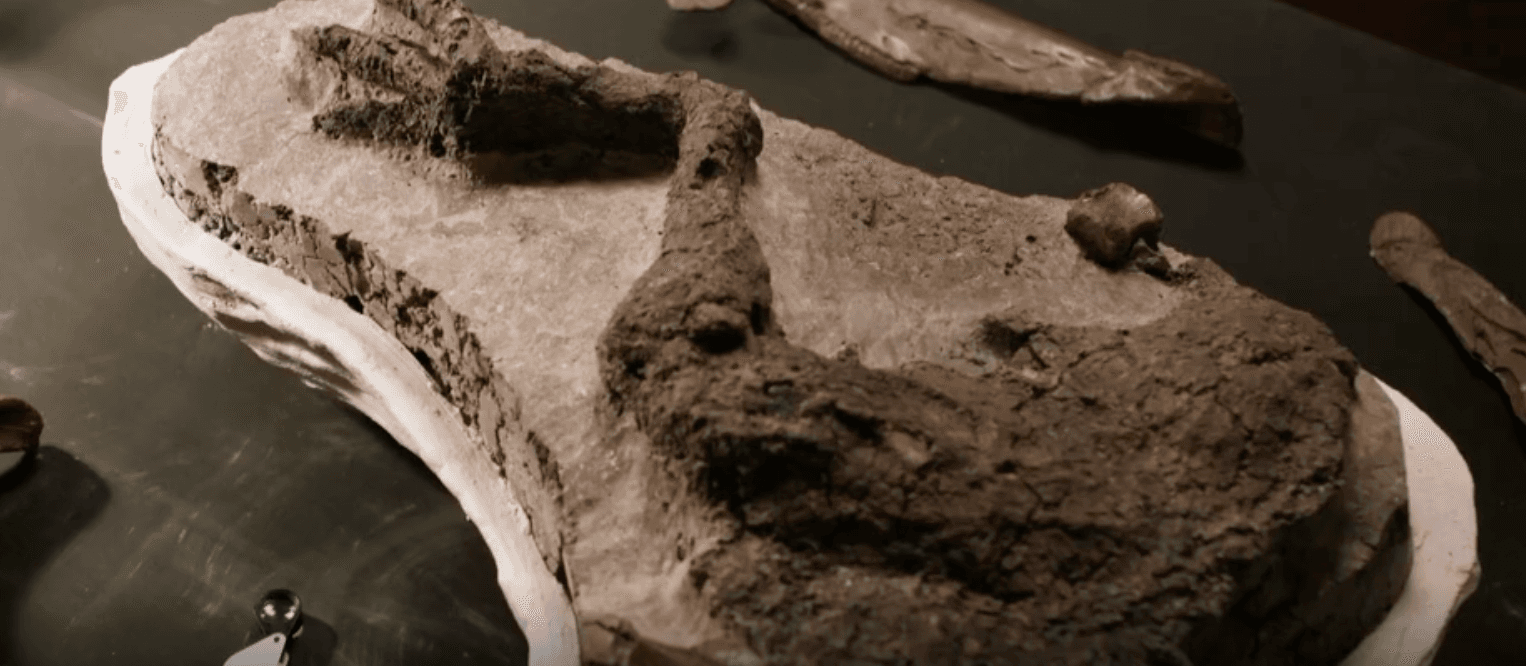
Prof Paul Barrett from London's Natural History Museum confirmed that the leg belonged to a Thescelosaurus.
[caption id="attachment_328361" align="alignnone" width="970"]
 Via BBC[/caption]
"It's from a group that we didn't have any previous record of what its skin looked like, and it shows very conclusively that these animals were very scaly like lizards," he said." They weren't feathered like their meat-eating contemporaries."
He continued: "This looks like an animal whose leg has simply been ripped off really quickly.
"There's no evidence on the leg of disease, there are no obvious pathologies, there's no trace of the leg being scavenged, such as bite marks or bits of it that are missing."
"So, the best idea that we have is that this is an animal that died more or less instantaneously."
Other finds include a fossilised turtle impaled by a wooden stake, remains of small mammals, skin from a triceratops and the embryo of a flying Pterosaur inside its egg.
[caption id="attachment_328359" align="alignnone" width="1530"]
 Via BBC[/caption]
"We've got so many details with this site that tell us what happened moment by moment, it's almost like watching it play out in the movies," Robert DePalma of the University of Manchester and the Tanis dig lead told the BBC. "You look at the rock column, you look at the fossils there, and it brings you back to that day."
Interestingly, the Tanis dig site is 3,000km from where the asteroid hit the Earth in the Gulf of Mexico, off the Yucatan Peninsula. Researchers say this demonstrates just how powerful its impact and initial devastation was.
Centuries of environmental attacks have left fossils jumbled together, with land and sea creatures now occupying the same space underground. Spherules, small particles of molten condensation, were also found in the gills of fish remains, pointing to the creature breathing in toxic fumes before it met its end.
Such spherules have been chemically and radiometrically dated to the Mexican impact location, meaning: "we're looking at a piece of the impactor; of the asteroid that ended it for the dinosaurs," explains Prof Phil Manning, DePalma's PhD supervisor at Manchester University.
Preserved tree resin at the site containing fallout also points to an extraterrestrial origin.
Dinosaurs: The Final Day with Sir David Attenborough will be broadcast on BBC One on April 15.
Explore more on these topics:
The world could end in 25 years, says Oxford scientist
Climate Change

News

News

News

News
Loch Lomond crash: boy, 16, and man, 80, killed in light aircraft crash near Drymen
Major incident declared after fatal plane crash Two people have died following a light aircraft crash in Stirlingshire, prompting a major emergency response and an investigation into the circumstances surrounding the incident. The victims were a 16-year-old boy and an 80-year-old man, who were both found dead after the aircraft came down near Drymen on […]
News
1 day ago
White House press secretary Katie Zacharia fired after five days in position
It comes after Trump said she should ‘reconsider’ her job White House press secretary Katie Zacharia has been fired after five days in the position, as per reports. Zacharia had a tough start to life in the role, hosting a briefing on Tuesday which caused a lot of criticism and raised a number of questions. […]
News
2 days ago
Piers Morgan urges Trump to side with Ukraine against ‘modern-day Hitler’ Putin
News