









Tech

Share
Published 15:50 26 Jul 2022 BST
Updated 16:23 26 Jul 2022 BST
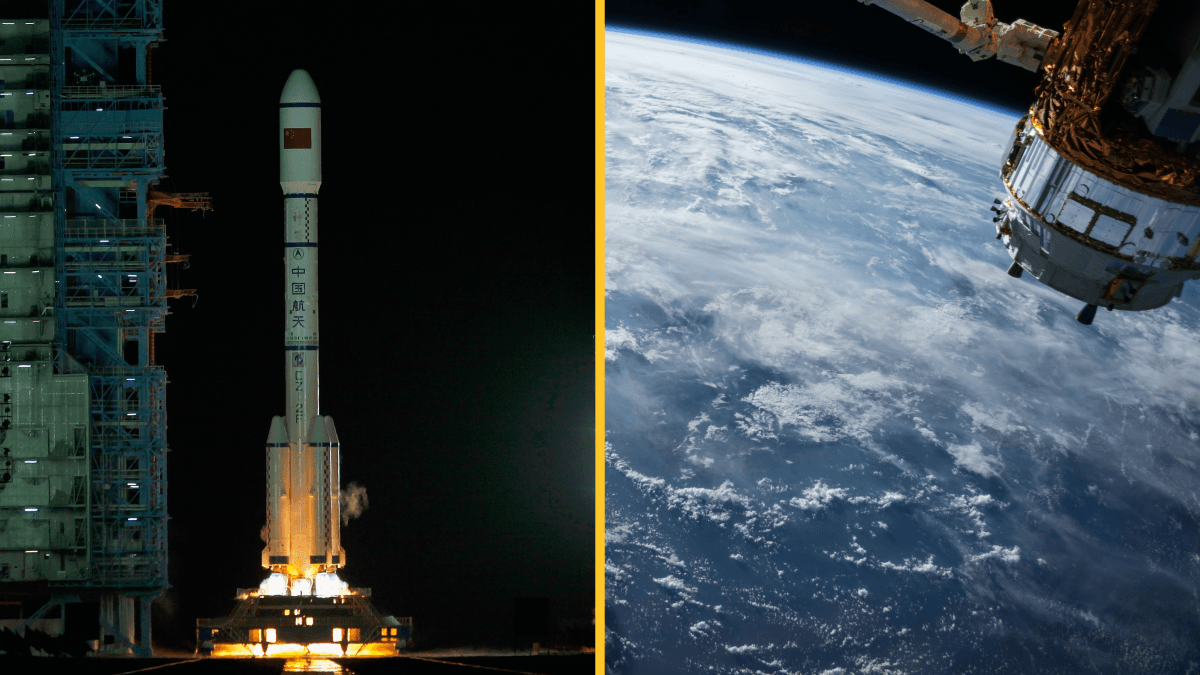
 Tiangong space station/Via Getty[/caption]
Speaking to Gizmodo via email, Jonathan McDowell from the Harvard-Smithsonian Center for Astrophysics said that, typically speaking, American space launches tend to do a better job at "upper stage disposal" compared to China.
"Unfortunately we can't predict when or where," he said. "Such a large rocket stage should not be left in orbit to make an uncontrolled reentry; the risk to the public is not huge, but it is larger than I am comfortable with."
https://twitter.com/planet4589/status/1551244348498616320?ref_src=twsrc%5Etfw%7Ctwcamp%5Etweetembed%7Ctwterm%5E1551244348498616320%7Ctwgr%5E%7Ctwcon%5Es1_&ref_url=https%3A%2F%2Fd-34499239462677374840.ampproject.net%2F2207071723000%2Fframe.html
The odds of the rocket hitting a populated area are low, but that's not because the planet has a great defence system for such occurrences. The chances are so small because the earth is 80 per cent water, but still, it's not impossible.
The experts believe there is a 10 per cent chance that one of more casualties will be caused by the debris over the next decade.
This is not the first time China has littered space, and earlier this year, it dumped part of the Tianhe space station at such speeds that it moved around the earth once every 90-minutes. Scientists were also unable to track it.
Tiangong space station/Via Getty[/caption]
Speaking to Gizmodo via email, Jonathan McDowell from the Harvard-Smithsonian Center for Astrophysics said that, typically speaking, American space launches tend to do a better job at "upper stage disposal" compared to China.
"Unfortunately we can't predict when or where," he said. "Such a large rocket stage should not be left in orbit to make an uncontrolled reentry; the risk to the public is not huge, but it is larger than I am comfortable with."
https://twitter.com/planet4589/status/1551244348498616320?ref_src=twsrc%5Etfw%7Ctwcamp%5Etweetembed%7Ctwterm%5E1551244348498616320%7Ctwgr%5E%7Ctwcon%5Es1_&ref_url=https%3A%2F%2Fd-34499239462677374840.ampproject.net%2F2207071723000%2Fframe.html
The odds of the rocket hitting a populated area are low, but that's not because the planet has a great defence system for such occurrences. The chances are so small because the earth is 80 per cent water, but still, it's not impossible.
The experts believe there is a 10 per cent chance that one of more casualties will be caused by the debris over the next decade.
This is not the first time China has littered space, and earlier this year, it dumped part of the Tianhe space station at such speeds that it moved around the earth once every 90-minutes. Scientists were also unable to track it.

Tech

Tech

Tech

Tech
Save 80% on this 5th Generation Apple iPad with 32GB Storage
Don’t miss out on this Apple iPad Wowcher offer Wowcher is running yet another tech offer you cannot miss out on this week, with 80% off a refurbished fifth-generation Apple iPad. If you’re looking to buy an iPad that won’t cost you a small fortune, then look no further than this Wowcher deal. Wowcher is […]
Tech
6 days ago
Urgent warning over convincing new scam appearing in people’s phone calendars
Calendar phishing is on the rise A suspicious appointment appearing in your Google Calendar could be part of a scam, even if you never opened the email that sent it. Cybercriminals are exploiting calendar settings to push fraudulent events directly into people’s schedules, hoping to trick them into handing over private information. Threat detection engineer […]
Tech
6 days ago
AI researcher resigns from job after issuing terrifying warning to humanity
Tech