







Politics

Share
Published 09:32 22 Aug 2026 BST
Updated 09:32 22 Aug 2026 BST
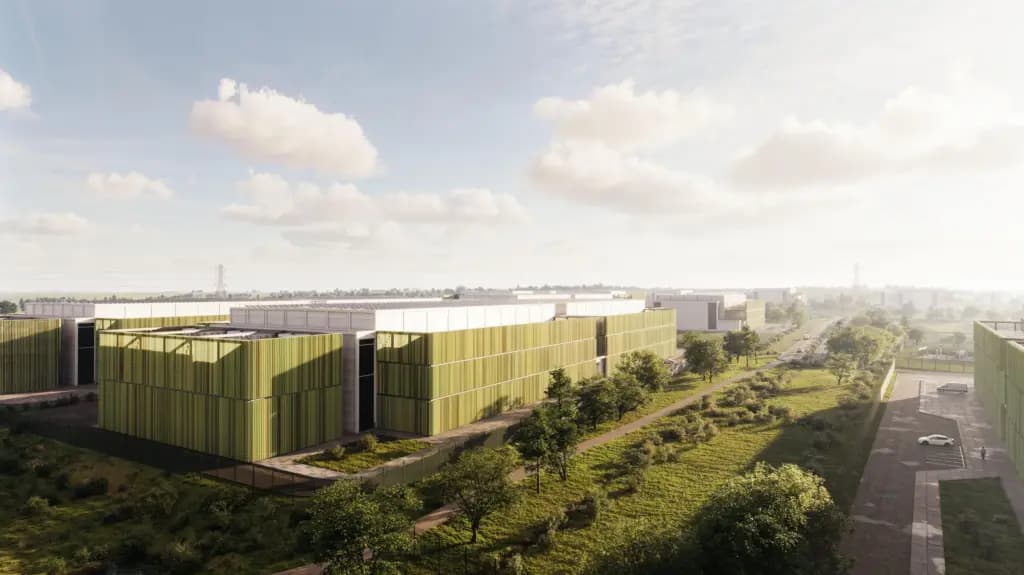
Plans for a huge new datacentre in east London have raised questions over its potential environmental impact, after planning documents revealed how much carbon the site could produce once fully up and running.
The proposed East Havering Data Centre Campus would cover around 218 hectares of green belt land at North Ockendon, on the outskirts of east London, and could become one of the largest datacentres in Europe if approved.
What makes the figures particularly striking is where they come from. The estimate of the site's carbon footprint was provided by the developer itself, rather than opponents of the project. According to an analysis of the planning documents by The Guardian, the facility could produce more than one million tonnes of carbon dioxide every year when operating at full capacity. That is roughly equivalent to the emissions from 27,000 flights between London and New York.
The company behind the proposal, Digital Reef, is seeking approval for a scheme estimated to be worth £14.7bn.
It has described the development as “a unique opportunity to create a sustainable datacentre campus of the future”, but its own application also acknowledges that the project “does not align with a science-based 1.5C compatible trajectory and achieving net zero by 2050”.
The proposed datacentre would have a 60-year lifespan, and the figures in the planning documents suggest its total emissions could exceed 72 million tonnes of CO2 equivalent over that period.
Once fully operational, that works out at around 1.2 million tonnes each year. According to The Guardian’s analysis, that would make the East Havering site the highest-emitting datacentre project in the UK where the developer has made its projected emissions public, out of dozens of schemes being proposed around the country.
The amount of electricity it would need is just as striking. Digital Reef estimates that, at what it describes as a “likely” 50% load, the campus would use around 2.65 billion kWh of electricity every year.
For comparison, Ofgem estimates that an average UK household uses about 2,500 kWh annually, meaning the proposed site would consume roughly the same amount of electricity as more than one million homes.
Keeping a facility of this size running would require a huge connection to the electricity network. The plans call for a 600MVA connection to the National Grid, supplied through the nearby Warley substation.
The location is also a major part of the proposal. The developers want to use 218 hectares of green belt land in outer London, which would put the datacentre close to the fibre networks and customers it needs to operate.
But that same location creates a major point of debate, because green belt land is protected from development, leaving councillors to decide whether a vast computing facility of this scale should be built there.
Donald Campbell, advocacy director at the tech justice nonprofit Foxglove, called the projected emissions "staggering".
It’s a big threat to the ability to decarbonise in the UK. It’s also going to be a big drain on important resources that are needed by homes and other businesses.
Donald Campbell, Foxglove
That argument lands differently in a summer when households have been told to cut back, with Joe tracking hosepipe bans across the UK and the wider shake-up of Britain’s energy industry reshaping where power and investment go.
The AI boom’s infrastructure has to be built somewhere, and the bill for connecting it is shared.
The final call will be made by Havering Council, which now has to weigh the scale of the proposed development against its environmental impact.
The fact that Digital Reef has itself acknowledged that the project does not fit with a 1.5C-compatible pathway or the UK’s 2050 net zero goal could give opponents a particularly strong argument against the plans.
The decision could also have implications beyond this one site. The government has backed the expansion of datacentres as part of its wider plans for economic growth, while the legally binding target of reaching net zero by 2050 remains in place.
If Havering approves a project of this size on green belt land despite the emissions figures included in its own planning application, it could create an important precedent for other datacentre proposals.
Future developers could point to the East Havering scheme when making the case for similarly large developments elsewhere.
Explore more on these topics:


Politics

Politics

Politics
Politics
Reform misspells party name in embarrasing Holborn and St Pancras by-election gaffe
One job… Reform have been involved in an embarrassing gaffe during campaigning for the Holborn and St Pancras by-election after the party managed to spell its name wrong on a letter. Today (October 8), voters are going to the polls in the North London seat to decide who will succeed Keir Starmer as their MP. […]
Politics
2 days ago
Holborn and St Pancras: who will win in Labour vs Green by-election?
On the eve of the Holborn and St Pancras by-election, we look at the state of play in North London. When Keir Starmer decided to complete his retreat from British politics by stepping down as MP in Holborn and St Pancras, it presented Andy Burnham with his first electoral test as Labour leader. Labour have […]
Politics
3 days ago

Politics
Politics