








News

Share
Published 16:10 22 Jun 2026 BST
Updated 16:10 22 Jun 2026 BST
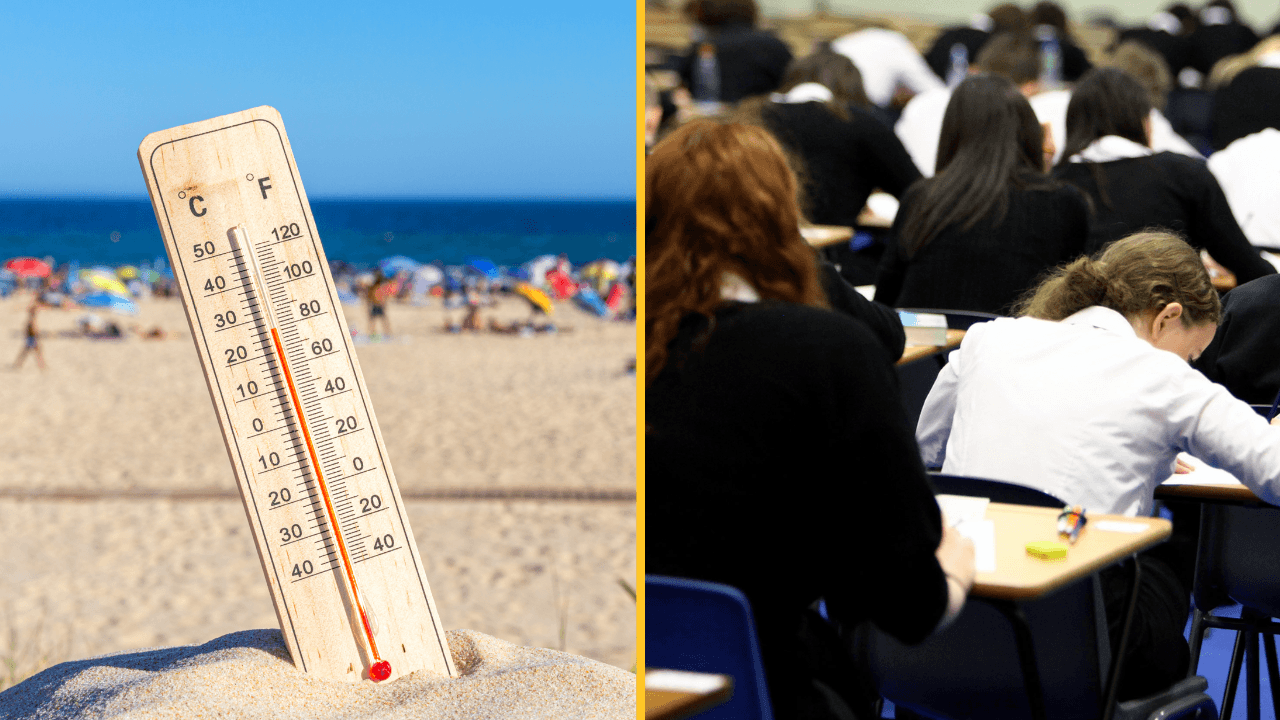
Brits across the country are feeling the heat, as the mercury soars this week, and red weather warnings have been issued for parts of the country.
The previous amber warning has been upgraded to a red 'danger to life' extreme heat weather warning by the Met Office.
With Keir Starmer cranking up the old weather machine as one last hoorah after resigning today as prime minister, it looks like we're set for some scorching heat as high as 38C in some places.
The warning is in place for Wednesday, 24 June and Thursday 25 June.
However while some readers may rejoice at the higher temperatures, it could pose some problems for children going to school in the warmer weather.
As per government guidance, school attendance is the most important priority for children's well-being and schools should stay open, even in heatwave conditions.
This said, it is just important that school leaders keep children safe in the hot weather, making any adjustments necessary to protect kids, especially as they can be more susceptible to the heat.
This said, it is unlikely any schools will close.
One common measure taken by schools as the mercury skyrockets is to allow students to wear lighter uniform, such as P.E kit and shorts, instead of shirts, blazers and trousers.
Meanwhile the Department of Health and Social Care recommends that PE lessons in particular should be adapted to avoid strenuous physical activity as well as encouraging kids to stay inside.
A great emphasis is placed on hydration and easy access to water.
Teachers are advised on best practice at keeping the classroom cool by opening windows overnight or early in the morning before closing them as the temperature rises in the day.
This along with keeping doors open and curtains closed should help minimise the impact of the heatwave.
For commuters in London, for example, many of its features aren't equipped for warm weather, including several Underground lines.
Additionally, some of the capital's historic buildings and offices weren't built to stay cool and don't have the best circulation when temperatures rise.
So, it's safe to say you can count your blessings if you work in one of the city's more modern buildings.
Nonetheless, not all hope is lost if you don't, as bosses need to be mindful of office temperatures according to the Workplace Regulations set out in 1992.
Those regulations state that employers must legally provide a workplace with a "reasonable" temperature and good ventilation.
However, there is no minimum temperature or temperature limit for workplaces, meaning employers rather rely on recommendations than actual law.
According to the Approved Code of Practice, the lowest recommended temperature is 16ºC, or 13ºC when it's physical work, but there's no such guidance for other lines of work.
For that reason, it's more up to what your boss considers a "reasonable" workplace temperature.
Although there are no current laws on workplace temperatures, Labour are reportedly considering making it illegal to work when it's too warm.
A new report from the climate change committee (CCC) recommended introducing maximum workplace temperatures, amid the risks of climate change to the UK.
The CCC's report said that by 2050, summer in the UK is predicted to be 'significantly warmer', with temperatures of 40C or even 45C expected to be seen in southern areas of the country.
“Maximum working temperature regulations would address the increasing risks that high temperatures pose to workers’ safety and incentivise the deployment of the necessary cooling," the report said.
"Businesses are largely responsible for investing in their own adaptations but must ensure that workplaces and working practices are safe for employees, including for those working outside.”
The CCC highlighted Spain as an example of a country with legal limits on temperature in the workplace.
Employers in Spain are responsible for meeting the requirement of 27C for sedentary work and 25C for light physical work, and if they fail to do so then employees can report them.
However, the workplace regulator Health and Safety Executive (HSE) are expected to stop short of introducing a legal maximum limit, in their development for plans of protections during hot weather.
Environment Secretary Emma Reynolds said the government will “carefully consider” the CCC's recommendations.
“We are acting to protect people and places from the impacts of climate change that are already being felt across the UK – from flooding to extreme heat and drought.
“Robust, independent science is essential and we will carefully consider the climate change committee’s latest recommendations to drive further action.”

News

News
News

News
Rejoining EU could boost UK economy by £150bn – Goldman Sachs
Analysts from the bank reckon a ‘Breturn’ would boost the UK economy by 2-5% by the start of the next decade. Goldman Sachs has said rejoining the European Union could boost the UK economy by as much as £150 billion. In a note to clients, the Wall Street bank voiced its support for Andy Burnham’s […]
News
19h
Travel chaos across Italian airports after air traffic control failure
Air traffic management capacity has been slashed in half Travel chaos has struck Italy’s major airports after an air traffic control failure left capacity halved on Friday. Hundreds of flights across Italy have been delayed and over 100 cancelled due to “anomalies” with air traffic control (ATC) services. The Italian air navigation service provider, ENAV, […]
News
1 day ago

News
Abu Dhabi Royal was found passed out on street in London after ‘cocaine binge’
News