









News

Share
Published 13:28 30 Oct 2026 GMT
Updated 13:30 30 Oct 2026 GMT
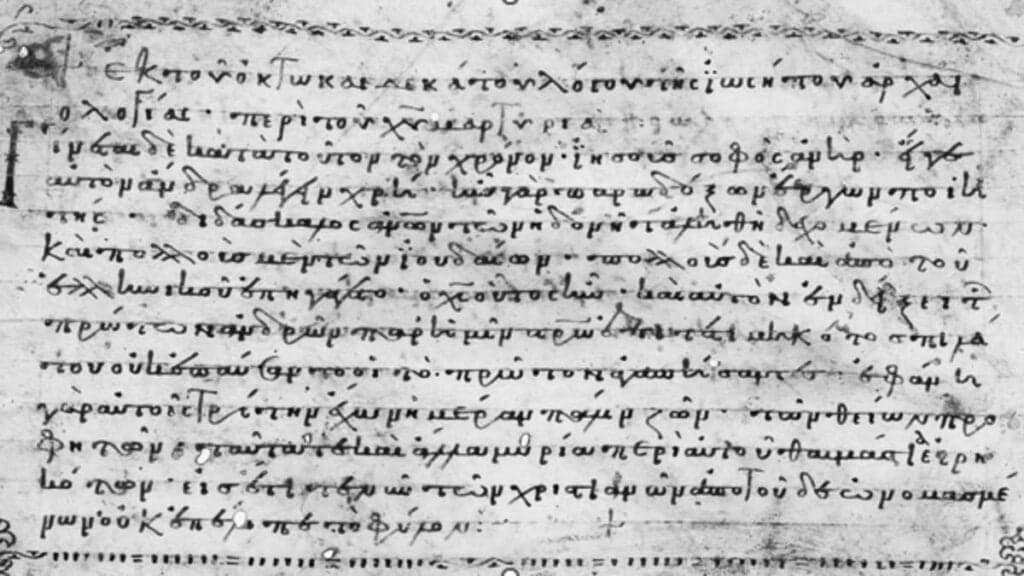
A controversial passage about Jesus in an ancient history book may have been rewritten by later Christian authors, according to a new study examining how the text changed over time.
The passage appears in Jewish Antiquities, completed around AD 93–94 by Flavius Josephus, a Jewish historian who was not Christian.
Known as the Testimonium Flavianum, it describes Jesus’ life and crucifixion before referring to his reported resurrection.
However, scholars have long questioned whether Josephus wrote the entire account or whether Christian copyists added some of its more religious claims.
Spanish independent researcher Jesús Fernández-Pedrera Correa has revisited the debate by comparing Greek, Latin, Arabic and Syriac versions of the passage.
His preprint, published on August 15 and originally reported by the Daily Mail, looks at differences that could help identify the historian’s original wording.
One of the clearest discrepancies concerns Jesus’ identity.
The Greek text directly states that he “was the Christ”, while the Latin, Arabic and Syriac versions use more cautious language, describing him as someone who was believed to be the Messiah. The Arabic account even suggests that perhaps he was.
Fernández-Pedrera Correa argues that the stronger declaration may have been added by Christian writers who wanted the passage to reflect their beliefs.
He also points to Origen, an early Christian author who said in the third century that Josephus did not believe Jesus was the Christ.
Another reference in Jewish Antiquities may support the possibility that Josephus originally used more neutral language.
He describes James as the brother of Jesus “who was called Christ”, identifying Jesus without endorsing Christianity.
The wording surrounding the resurrection is more difficult to establish. In the Greek version, Jesus is said to have appeared alive on the third day after his crucifixion, following predictions made by divine prophets. It reads as a statement that the event happened.
The Arabic version presents a different account, saying Jesus’ disciples “reported that he appeared to them” alive three days later.
This suggests Josephus may have been recording what his followers claimed to have witnessed, without personally confirming the Resurrection.
The researcher believes Christian copyists could have changed the original wording to make the event sound more like an established fact.
However, he considers this interpretation less certain than his argument about the Messiah reference.
There are considerable limitations to the research. The Latin version dates to around AD 392, while the Arabic and Syriac texts survive in works from the 10th and 12th centuries.
No manuscript from Josephus’s lifetime has survived, leaving researchers dependent on much later copies and translations.
Image credit: Oxford University
Explore more on these topics:

News

News

News

News
Legendary actor Sir Patrick Stewart dies aged 86
RIP Sir Patrick Stewart, one of the most recognisable faces in science fiction, has died at the age of 86. Best known to generations of viewers as the commanding Captain Jean-Luc Picard in Star Trek and Professor Charles Xavier in the X-Men movies, the veteran performer died at his Los Angeles residence on Wednesday. His […]
News
17h
‘Charred remains of Noah’s Ark found’ as researchers continue dig at historic site
The site has fascinated Ark hunters for decades Wood from Noah’s Ark has potentially been discovered in Eastern Turkey, researchers have revealed. According to researchers, the so-called discovery was made in the Durupınar Formation. This is a roughly 538-foot-long geological structure near Mount Ararat. The site, which was discovered in 1959, for decades has fascinated […]
News
20h

News
Man detained after Monaco royal found dead aged 29
News