







Entertainment

Share
Published 15:01 20 Aug 2020 BST

 Photo: Erik McLean on Unsplash[/caption]
Just imagine how much grub Manchester United fans got through watching Maguire and Lindelof try and defend against Sevilla.
So how did scientists come to this conclusion?
Researchers tested 120 people, giving them lower and higher calorie drinks and giving them tasks which demanded both low and high amounts of attention. The drinks were then followed by snacks, to judge how much people would eat while distracted.
People who were given a task where they had to pay a high level of attention to something distracting them were less able to judge when they felt full. As a result, they ate more of the snacks offered to them.
However, people who were given a less-distracting task consumed 45% less of their snacks.
Photo: Erik McLean on Unsplash[/caption]
Just imagine how much grub Manchester United fans got through watching Maguire and Lindelof try and defend against Sevilla.
So how did scientists come to this conclusion?
Researchers tested 120 people, giving them lower and higher calorie drinks and giving them tasks which demanded both low and high amounts of attention. The drinks were then followed by snacks, to judge how much people would eat while distracted.
People who were given a task where they had to pay a high level of attention to something distracting them were less able to judge when they felt full. As a result, they ate more of the snacks offered to them.
However, people who were given a less-distracting task consumed 45% less of their snacks.
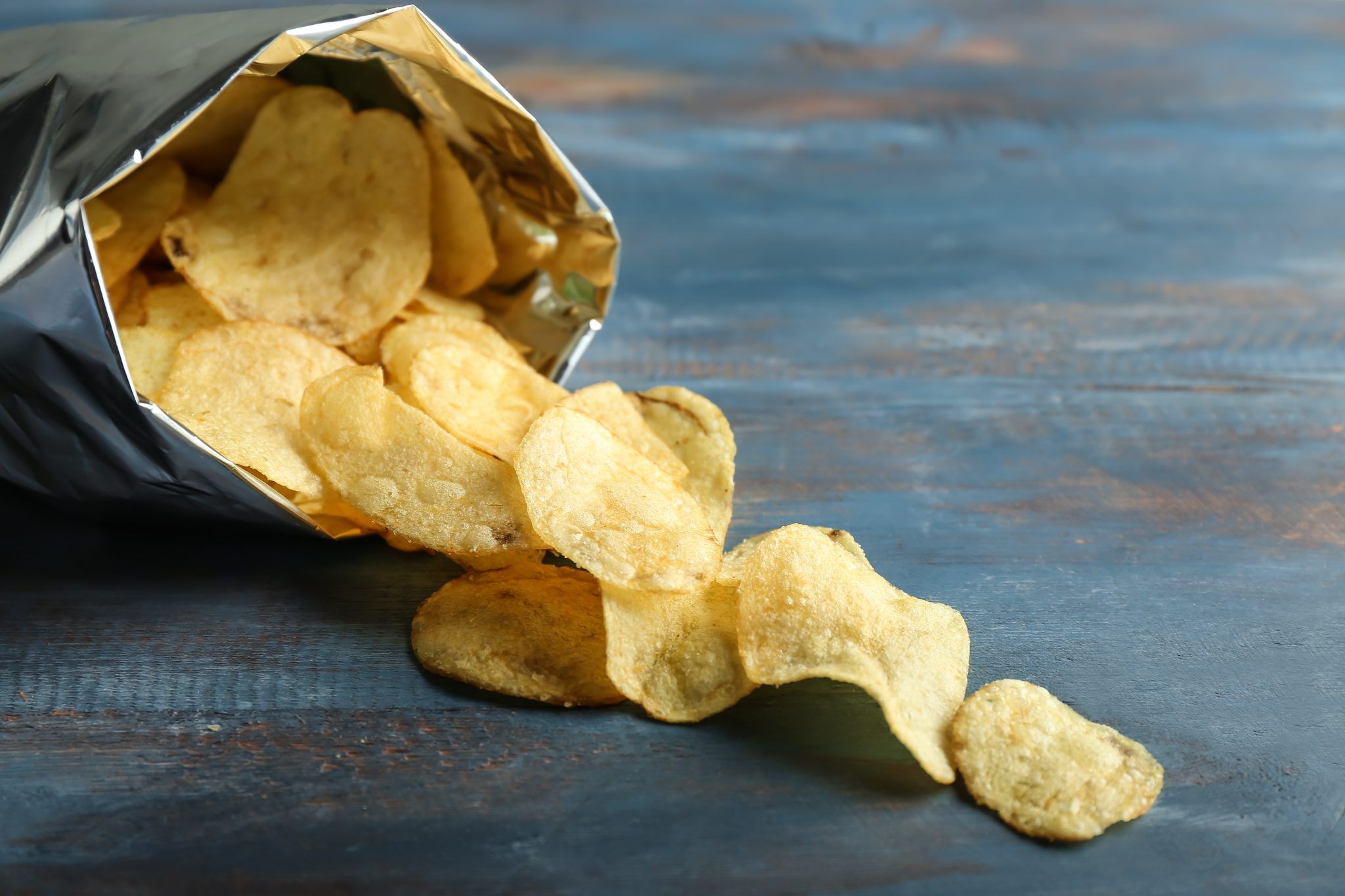 Participants were tested on how much crisps they ate while distracted. (Photo: iStock)[/caption]
Professor Martin Yeomans from the School of Psychology at the University of Sussex, said:
"Our study suggests that if you're eating or drinking while your attention is distracted by a highly engaging task, you're less likely to be able to tell how full you feel. You're more likely to keep snacking than if you'd been eating while doing something less engaging."
This has implications if you're trying to lose weight, says Yeomans.
"This is important for anyone wanting to stay a healthy weight. If you're a habitual TV-watching snacker - watching, an engaging thriller or mystery, or a film with a lot of audio or visual effects - you're not likely to notice when you feel full. Video-gamers and crossword solvers should also take note."
Previous studies have shown that feeling full can be affected by the texture and appearance of your meals.
"Now we also know that feeling full depends on how much sensory information our brains are processing at the time," says Yeomans.
Participants were tested on how much crisps they ate while distracted. (Photo: iStock)[/caption]
Professor Martin Yeomans from the School of Psychology at the University of Sussex, said:
"Our study suggests that if you're eating or drinking while your attention is distracted by a highly engaging task, you're less likely to be able to tell how full you feel. You're more likely to keep snacking than if you'd been eating while doing something less engaging."
This has implications if you're trying to lose weight, says Yeomans.
"This is important for anyone wanting to stay a healthy weight. If you're a habitual TV-watching snacker - watching, an engaging thriller or mystery, or a film with a lot of audio or visual effects - you're not likely to notice when you feel full. Video-gamers and crossword solvers should also take note."
Previous studies have shown that feeling full can be affected by the texture and appearance of your meals.
"Now we also know that feeling full depends on how much sensory information our brains are processing at the time," says Yeomans.Explore more on these topics:
Entertainment

Entertainment
Entertainment

Entertainment
Liberty X and Hear’Say reunite for joint 2027 arena tour
Two early 2000s pop groups are joining forces again Pop fans are getting a major early-2000s reunion, as Liberty X and Hear’Say prepare to hit arenas together for a 13-date tour around the UK and Ireland in 2027. The groups have spent six months quietly putting the plans together after deciding to reunite, with the […]
Entertainment
4 days ago
This 72-minute new thriller is one of the tensest movies of the year
‘An unforgettable, immersive watch.’ A new, 72-minute (not counting credits), genre-bending thriller has just been released, and you need to put it on your radar. The movie is titled Child and hails from Luxembourg. Directed by Cyrus Neshvad in his feature debut, the story introduces us in medias res to a couple named Anne (Brigitte […]
Entertainment
4 days ago

Entertainment
Vicky Myers wants Corrie to dig into Lisa’s secret past
Entertainment