





Entertainment

Share
Published 17:25 16 Oct 2025 BST
Updated 17:30 16 Oct 2025 BST
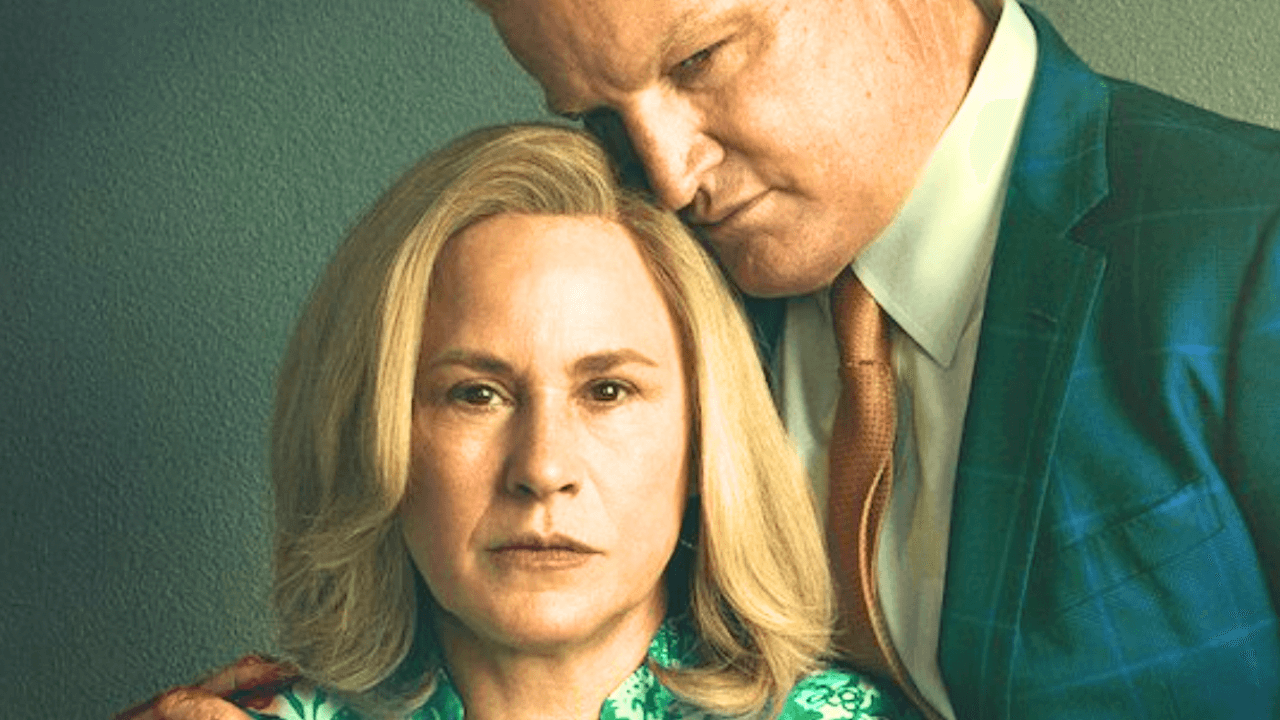
Disney+ has just added Murdaugh: Death in the Family, an excellent new true crime drama starring Oscar-winner Patricia Arquette (Severance), alongside Jason Clarke (Oppenheimer).
Inspired by the Murdaugh Murders Podcast, the series begins with Alex Murdaugh (an unrecognisable Clarke) calling the police to report that his wife, Maggie (Arquette) and son, Paul (Johnny Berchtold, Reacher), have been shot.
The story then flashes back in time several years to show the Murdaugh family living an idyllic-seeming life of privilege as members of one of South Carolina's most powerful legal dynasties.
Through the remaining episodes, the viewer witnesses the clan's perfect public facade start to crack.
JOE has seen five of the series' eight episodes, and we would highly recommend the gripping and disquieting true crime drama.
There can be risks when making shows based on stranger-than-fiction real stories of falling into exploitative territory. Yet, the creators of Murdaugh: Death in the Family, Erin Lee Carr (I Love You, Now Die) and Michael D. Fuller (the sadly underseen crime drama Quarry), sidestep this through their approach to this awful tale.
The series is less about the central crime. Instead, it places a greater emphasis on the people involved, as well as all of the events and mistakes that led to the shootings.
In the process, the show becomes an important cautionary tale about the perils of unchecked power and how, if one sweeps problems within a family under the rug, they can grow in severity and eventually spiral out of control.
Adding to this more human approach are the fiercely authentic performances.
Clarke is utterly transfixing as a popular and gregarious public figure whose genial outward persona masks a dark and selfish streak.
Arquette is also haunting as a wife and mother who is torn between doing what's morally right and protecting her sons (her other son, Buster, is played by Will Harrison, of Daisy Jones & The Six), as well as the Murdaugh family's reputation.
Ahead of the release of Murdaugh: Death in the Family, JOE interviewed Arquette and Clarke about the project.
The duo spoke to JOE, with the assumption that people watching would know the real-life events. So, if you are unaware of what happened but would like to check out the show, maybe proceed with caution for fear of spoilers.
Our first question for the pair was what drew them to the series, with Clarke responding: "Well, I thought I'd like to see this story dramatised. I'd like to see behind the trial and the whodunit side of it, to the real people.
"It was obviously going to be a ginormous challenge, but the scripts seemed to be speaking to the tragedy behind it rather than the shock horror of it."
Arquette, similarly, found the more human-focused approach fascinating.
Speaking about the real-life Alex Murdaugh, the Oscar-winner added: "There's the facts in the case and the shocking things that he did... and we discovered.
"But there was [also] a real ripple through the whole community and this family, that they were like: 'Who is this guy? We've known this guy for years. We love this guy. We have a history with this guy. Who is he?'"
Arquette said she was interested in examining "these family patterns of alcoholism and drug use" and to ask: "What does this look like in a dysfunctional space?"
"Then just the dynamic of love and being in a marriage and having kids and worrying about your kids and your kids making choices that were modelled for them," the Oscar-winner also added, when describing why she was drawn to the project.
"The guilt and the concern and that fear, for my character. Even though it's not really her nature, she's saying: 'Yeah, use your access, use how you can get away with things.'
"All these pressure points start pinching on these different areas and impact all these different people."
In preparing for the series, the actress also said she researched narcissists and sociopaths, particularly the experiences of the partners of people with these disorders.
She told JOE that a person with a personality disorder can be "charming and beguiling", but also "confusing and deceptive" and that it can be hard to see the latter traits "when you're not like that".


"You really don't expect that of people," Arquette said. "Oftentimes, in these relationships, people didn't really realise for like a decade... That's kind of normal. There are all these defences and protections that go along the way.
"Some of the things that start happening to them - they've been gaslit so long and not pressed for answers and not wanted to dig in, and [have] maybe cut people a lot of slack, so they start having an awakening from this cognitive dissonance.
"Their bodies, a lot of times, they'll wake up at like three in the morning, shaking.
"There's a lot of shame that goes along with it. We have this scene later on with her sister, and she's at the beach house. And a couple of times, she can barely really look at her sister in these scenes.
"There's so much shame around this kind of stuff.
"So, looking at personality disordered people, I mean, I'm not a psychologist, but the things that [Alex Murdaugh] did - pathological lying, charming people, deceiving, manipulation, stealing - these are all common components of that.
"And oddly enough, the most dangerous part [is] for the partner. When it often becomes physical and deadly, is when they really start to see who that person is."
Clarke has been one of Hollywood's most reliable character actors in recent years, taking on a vast array of varied roles in the likes of Dawn of the Planet of the Apes, The Devil All the Time, Everest, Lawless, Pet Sematary, Public Enemies, Oppenheimer and Zero Dark Thirty.
That said, Murdaugh: Death in the Family is the most that the acclaimed Australian performer has altered his appearance for a project. This was so that he could better resemble the real-life Alex Murdaugh.
JOE had assumed that this physical transformation was accomplished via prosthetics. Yet, Clarke assured us, this was not the case:
"There were no prosthetics. That was a choice early on that was governed by the reality of the shooting day.
"Also, I think, we wanted [the] feeling that I'm not an actor hiding behind a creation, I am it, and if we could get into the ballpark, if I can put on the weight, if we can get the hair and the wig and the skin tone, all that right, that, we'd present something much more visceral and tangible and human in our telling of this tale. So, that's what we went after.
"It was a big change, and it was a credit to hair, makeup, wardrobe and everybody involved, my wife cooking me very heavy, big meals and forcing me to eat, and then helping me get that weight off too, when I needed it for the end.
"It's such a part of who he was. He talks about it. He was heavy at 265 [pounds], when it all came down, and it was funny how, then, in the trial, he got lighter and stronger as the drugs disappeared.
"The weight started to come off, his mind started to get sharp again. His nerves actually came back in because his life was on the line."
When we asked Arquette and Clarke what they wanted viewers to take away from Murdaugh: Death in the Family, the Severance star said:
"You've got to pay the cheque in life. You reap what you sow. These things, they start as one little thing and then another little thing, and they build on themselves.
"Jason's such an incredible actor. He came in, [and] he had to really drive this whole show. [His character's] manipulating and getting this fixed and being the daddy of everybody and taking care of business and being the fun guy and the manipulator and all these different things all the time.
"All those things that are done in secret that damaged people, it's a bad road. It's a bad path, and it hurts everyone in the end."
Explore more on these topics:
Kieran Hayler cleared of raping 13-year-old girl
Entertainment

Entertainment
Entertainment
Entertainment
Entertainment
Kieran Hayler cleared of raping 13-year-old girl
Jury reaches verdict in Kieran Hayler trial Katie Price’s former husband Kieran Hayler has been acquitted of all eight charges brought against him following a trial at Lewes Crown Court. The jury returned its verdicts on Thursday, finding the 39-year-old not guilty of three rape charges, one count of sexual assault and four alternative charges […]
Entertainment
1 day ago
Richard Madeley leads Good Morning Britain tribute to cameraman Donovan Parsons
GMB stars pay emotional tribute to beloved colleague Richard Madeley, Ranvir Singh and Laura Tobin have paid tribute to their colleague Donovan Parsons after the longtime ITN cameraman died following a battle with cancer. Parsons had spent 25 years working with ITN, including alongside the team behind Good Morning Britain. His death was announced on […]
Entertainment
1 day ago
Entertainment

Entertainment
Rape Crisis Centre slams Irish comedian for joke about rape
Entertainment