

News

Share
Published 16:11 19 Jun 2026 BST
Updated 16:17 19 Jun 2026 BST
Written by Vesa Hyseni
Few moments at the FIFA World Cup highlight the connection between the nations quite like the build-up before the game starts.
As players step out on the pitch, the display of flags and the sound of national anthems create a shared pause in the action, turning the match into something bigger than sport and underscoring the tournament’s global identity.
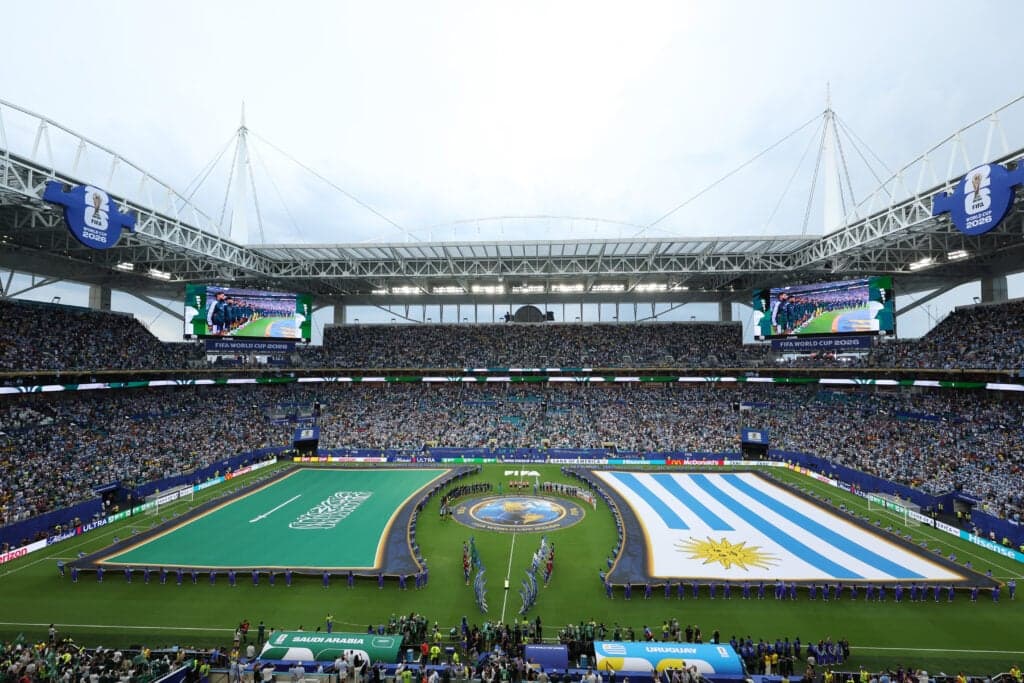
At this year’s competition, FIFA has placed an even stronger focus on presentation and symbolism by extending the pre-match routines, with large scale flag displays and all players now positioned together in the center circle during the anthem, creating a more unified and visually striking ceremony.
According to FIFA, this is done to deliver a “unique, immersive experience” that reaches every spectator in the stadium, ensuring that the atmosphere, emotion and sense of occasion can be fully felt from any seat.
In most games, the pre-match ceremony includes placing each nation’s flag directly on the grass, which is something that the viewers have come to expect as part of the tournament’s visual presentation.
This is why it’s more noticeable when it does not happen and why fans were especially confused when they saw that Saudi Arabia’s flag was the only one who wasn’t placed directly on the pitch.
This immediately sparked questions, with many wondering what the reason for the exception was.
As you might guess, the reason behind this is religious in nature. The Saudi Arabian flag carries the Shahada, the Islamic declaration of faith, which reads: “I bear witness that there is no god but God, and I bear witness that Muhammad is the Messenger of God.” The inscription is one of the core tenets of Islam. Beneath the text sits a sword, symbolising the strength and unity of the kingdom.
Because of these elements, the flag is regarded as a sacred symbol and as a result, there are strict guidelines governing how it can be displayed.
According to these guidelines, the flag can’t be lowered or handled in a way that could be seen as disrespectful, and it is prohibited from touching the ground or being placed beneath anything else.
This is why, unlike other nations whose flags may be used more freely in celebrations or stadium displays, Saudi Arabia’s flag is treated with a higher level or reverence, making its use on the pitch more restricted.
To ensure that the ceremony can continue in a way that respects cultural sensitivities, Saudi Arabia and FIFA reached a compromise that would adjust the format instead of removing the visual element entirely.
The compromise is that, in matches involving Saudi Arabia, the national flag is not placed on the pitch but it is carried by a group of volunteers so that it never comes in contact with the grass.
To keep the presentation visually consistent though and to avoid drawing attention to a single team, FIFA has decided to extend the same arrangement to the other team playing as well, so that both flags are being held rather than laid out.
News
News

News

News
Man who died in horror 150ft stadium fall named
The incident was seen by thousands A man who died after plunging 150ft (46m) in a horror stadium fall has been named. US Airman Tech Sargent Ian Patterson of the US Air Force died from his injuries after falling from the rafters of Texas’ Alamodome stadium. He was doing a fast-rope demonstration when the incident […]
News
2h
Two men and two women arrested after police officer shooting in Nottingham
BREAKING After a police officer was shot and injured in Nottingham city centre on Sunday, police have confirmed that arrests were made. The shooting occurred in the early hours of Sunday morning. Two men and two women have now been arrested in connection to the shooting. The Nottinghamshire Police officer was shot in the foot, […]
News
5h
Wainwright fire kills several at Canada military base
News