







News

Share
Published 16:05 9 Jun 2025 BST
Updated 16:05 9 Jun 2025 BST
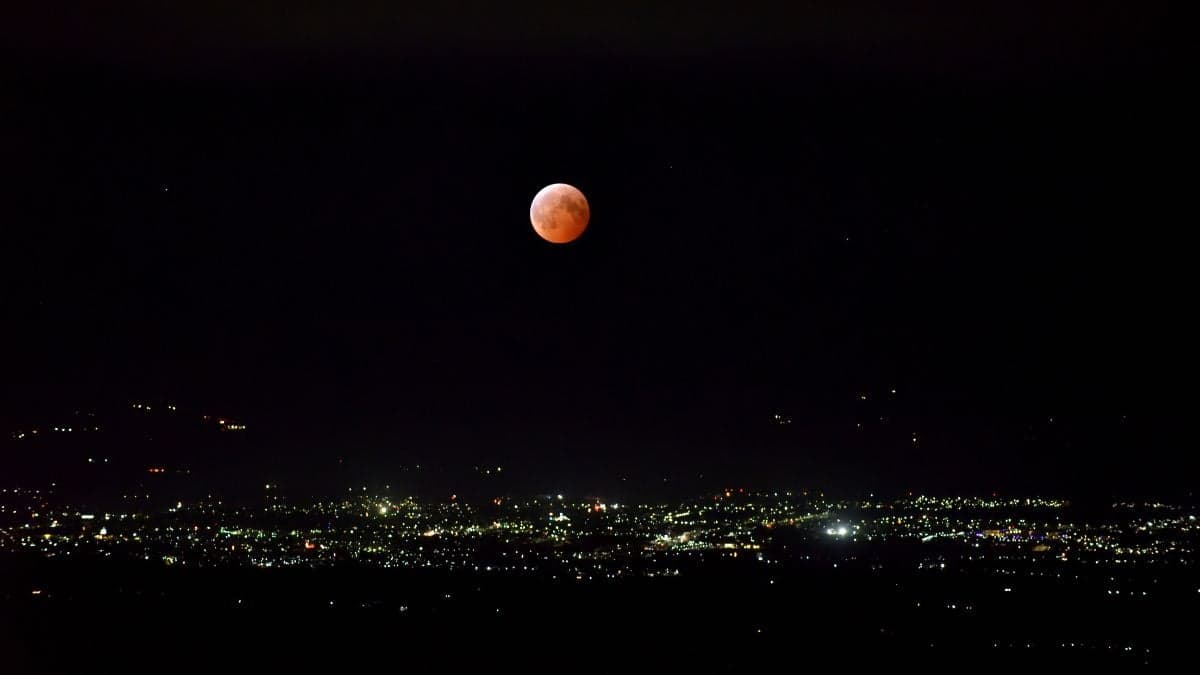
This month's full moon phenomenon won't be seen again until 2045.
A full moon appears every 29.5 days, which is the length of time it takes for the moon to go through one entire lunar phase cycle.
In other words, a full moon appears when the lunar surface that faces Earth is fully lit up by the Sun.
This Wednesday (June 11) the last full moon of Spring in the northern hemisphere will light up UK skies.
However, June's full moon will look different this year due to a recent phenomenon called a 'major lunar standstill'.
The Moon follows a unique, tilted orbit around Earth, across the Moon's nearly 20-year-long-cycle.
Consequently, events called major and minor lunar standstills occur. This is when the Moon's monthly range of rising and setting positions on the horizon reaches its maximum or minimum limits, resulting in the Moon appearing unusually low or high in the sky.
During this month's Strawberry Moon, Earth will approach its farthest distance from the Sun in its orbit, while the Moon will also be as far from the Sun as it can be in its orbit around Earth.
Anyone looking out for the Moon on Wednesday will notice it will appear far larger than usual. This is due to its proximity to the horizon.
This phenomenon is known as the 'Moon illusion'.
Before anyone gets their hopes up, the Strawberry Moon, will not appear a vibrant strawberry-red.
The name comes from the wild strawberries that start to ripen during early summer, according to the Farmers' Almanac.
Nicknames are given to each month's full moon. January's full Moon is known as the 'Wolf Moon', and February's full moon is named the 'Snow Moon'.
That being said, June's 'Strawberry Moon' might have a bit more in common with its nicknames than its predecessors.
The Strawberry Moon might appear slightly orange or rusty red.
When the Moon sits close to the horizon, it can appear reddish because the light rays must pass through the densest layers of the atmosphere.
This can be compared to a 'Blood Moon' phenomenon seen during a partial lunar eclipse. When sunlight is filtered through the Earth's atmosphere, it scatters out most of its blue light, resulting in red hues reflecting off the Moon's surface.
The Strawberry Moon will rise on June 11 at 10.46 pm BST, and it will reach its full phase at 8.44 am BST.
On June 11 the sun will rise at around 4.45 am, therefore it will already be light when the Strawberry Moon reaches its full lunar phase.
However, the best time to look out for the phenomenon will be at dusk on Tuesday (June 10).

News

News
News

News
Rejoining EU could boost UK economy by £150bn – Goldman Sachs
Analysts from the bank reckon a ‘Breturn’ would boost the UK economy by 2-5% by the start of the next decade. Goldman Sachs has said rejoining the European Union could boost the UK economy by as much as £150 billion. In a note to clients, the Wall Street bank voiced its support for Andy Burnham’s […]
News
1 day ago
Travel chaos across Italian airports after air traffic control failure
Air traffic management capacity has been slashed in half Travel chaos has struck Italy’s major airports after an air traffic control failure left capacity halved on Friday. Hundreds of flights across Italy have been delayed and over 100 cancelled due to “anomalies” with air traffic control (ATC) services. The Italian air navigation service provider, ENAV, […]
News
2 days ago

News
Abu Dhabi Royal was found passed out on street in London after ‘cocaine binge’
News