Share
Exact time and place you could see the Northern Lights tonight
Published 13:52 20 May 2024 BST
Updated 13:52 20 May 2024 BST
Homenews
The Met Office has confirmed they could be visible
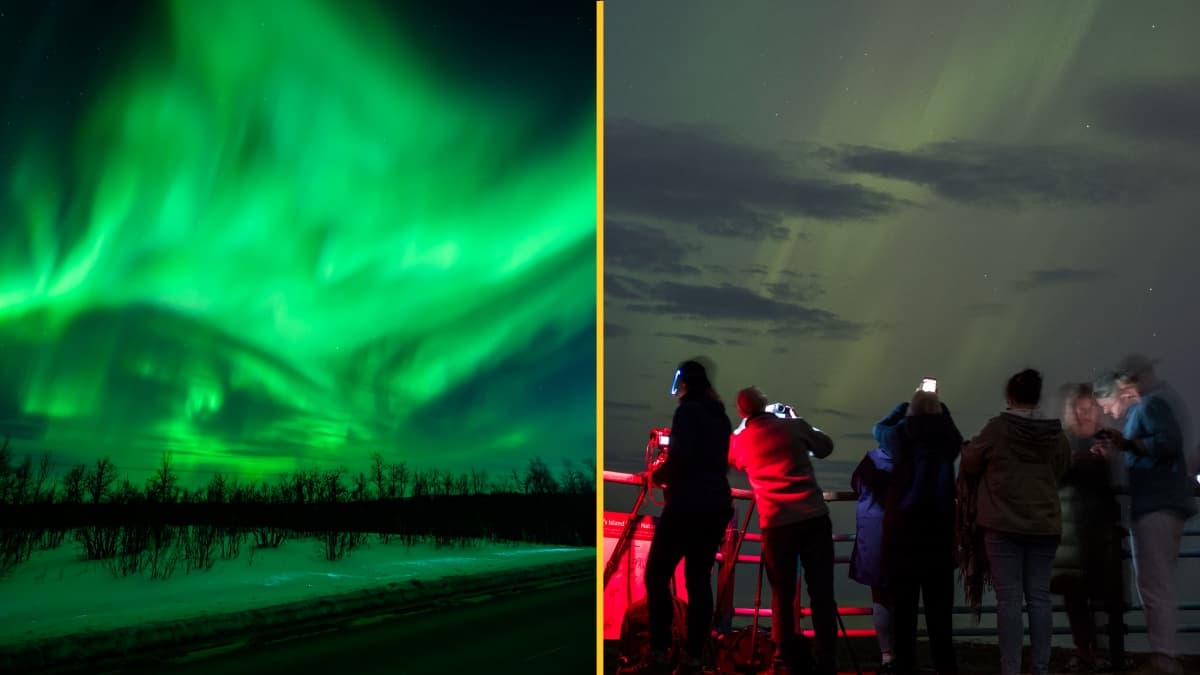
The Northern Lights could be visible in the UK yet again tonight.
Over the last couple of weeks, the lights, also known as the aurora borealis, have been seen across large parts of the country, treating Brits to some amazing displays.
And, whilst they won't be visible to quite the same extent as previously, the Met Office has confirmed the lights could be visible in the UK again tonight, from around 9pm.
This is thanks to the a coronal mass ejection that left the sun late on Friday (May 17), they said.
The forecaster said: "There's a chance of some aurora visibility in the far north of the UK tonight, with any viewing potential largely restricted to Scotland and Northern Ireland.
"Any visibility will be significantly less strong than was seen around two weeks ago, when auroras were seen over much of the UK."
The Met Office's aurora forecast states that there is a "slight chance" the lights could be seen in northern England and North Wales
The Met Office added the "chances of enhanced aurora activity are expected to decline after tonight", but that "with solar maximum likely in the coming months, further aurora sightings remain possible for the UK."
The Northern Lights is a natural phenomenon caused by charged particles energised by energy extracted from the solar wind hitting gases in the Earth’s upper atmosphere (above about 100 km up).
These gases are then energised, causing them to emit characteristic colours.
The two most abundant gases in the Earth’s atmosphere are nitrogen and oxygen.
Oxygen atoms glow green and red, but because the eye is more sensitive to green, this is the easiest colour to see in fainter displays. Nitrogen atoms, meanwhile, emit purple, blue and pink.
The aurora can commonly be seen near the poles of both the northern and southern hemispheres. In the north the display is known as the aurora borealis, and in the south it is called the aurora australis.
Usually, you’d have to travel to Iceland to catch a glimpse, but when solar activity is particularly strong, the lights can be seen further south, such as in northern parts of the UK.
Earlier this week, the Royal Astronomical Society suggested we could get another chance to see the spectacle this month.
The Sun is expected to reach the most active period in its 11-year solar cycle in 2024, making solar storms – and therefore the chance to see the Northern Lights – much more likely.
According to the RAS, the solar maximum is when the Sun has more sunspots than usual because its magnetic field is becoming stronger and at its most complex, which leads to the release of massive amounts of energy in the form of solar flares and, crucially for aurora, Coronal Mass Ejections.
In layman’s terms, there is a higher chance than usual that the lights could again be visible to much of the UK – perhaps even as early as tonight.
Related links:
Explore more on these topics: