








News

Share
Published 12:57 19 Apr 2016 BST

 Between 2007 and 2014, the "job-stayers" in the above bracket would have seen a 4.4 per cent median pay increase, while the "job-switchers" were looking at a comparatively massive 11.8 per cent in the same time slot.
In an economically strong society, job mobility should be relatively easy, and pay jumps therefore more common.
But as this chart from RF demonstrates, the 2008 recession made it much harder to move between jobs, and pay suffered for it.
[caption id="attachment_54028" align="alignnone" width="704"]
Between 2007 and 2014, the "job-stayers" in the above bracket would have seen a 4.4 per cent median pay increase, while the "job-switchers" were looking at a comparatively massive 11.8 per cent in the same time slot.
In an economically strong society, job mobility should be relatively easy, and pay jumps therefore more common.
But as this chart from RF demonstrates, the 2008 recession made it much harder to move between jobs, and pay suffered for it.
[caption id="attachment_54028" align="alignnone" width="704"]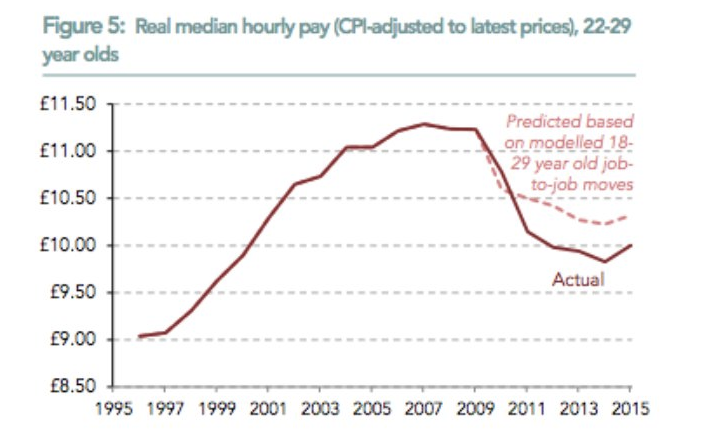 Credit: Resolution Foundation[/caption]
The report explained that if young people were able to change jobs more frequently then hourly pay would be around 30p higher, and warned that this needs to happen to avoid long-term damage to earnings.
Credit: Resolution Foundation[/caption]
The report explained that if young people were able to change jobs more frequently then hourly pay would be around 30p higher, and warned that this needs to happen to avoid long-term damage to earnings.
Laura Gardiner, Senior Policy Analyst at the Resolution Foundation, said:
Better get cleaning up that desk.“Frequent job moves are the main route to the rapid pay increases young people should experience as they begin their working lives. So it is a real concern that job switching slowed down for all groups, and particularly for young people, even before the recession hit.
“Unpicking the reasons why young people are staying put in their jobs for longer is crucial to understanding whether job switching can return to its previous level, or whether we are seeing a ‘new normal’ of fewer job moves and subsequent slower pay growth for generations to come.
“Unless we want to see a long-term scarring effect on the wages of future generations, Millennials must regain confidence and increase the frequency with which they move jobs, and firms must be more willing to take them on.”

Explore more on these topics:

News

News

News
News
Wainwright fire kills several at Canada military base
A nearby hospital declared a mass-casualty emergency A fire at a Canadian military base has caused the deaths of several people and left dozens of others injured. The fire broke out at Canadian Forces Base Wainwright on Saturday evening, as per the BBC. According to Canadian broadcaster Global News, which cited unnamed military sources, at […]
News
2h
Store closures confirmed as HMV and Typo shut UK shops
More high street closures as retailers battle rising rents The UK retail landscape is set for another shake-up, with four familiar names preparing to close stores as businesses grapple with expensive leases and changing sales. Stationery retailer Typo is withdrawing from the British market altogether, putting its remaining 13 shops at risk of closure. Meanwhile, […]
News
19h

News
Government plans to expand BBC licence fee with proposed ‘YouTube Tax’
News