







Tech

Share
Published 13:12 14 Oct 2018 BST

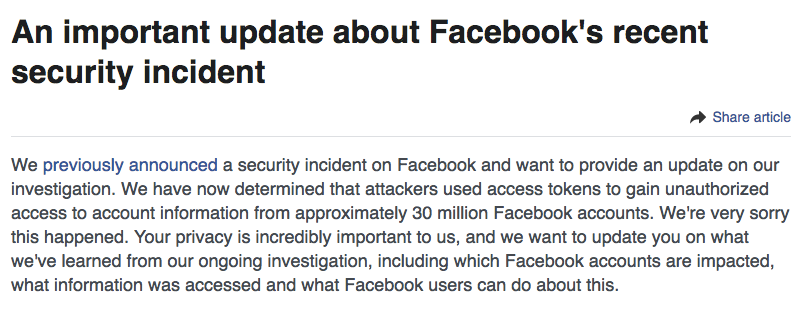 The page goes on to say that: "On September 25, 2018, we discovered that attackers had exploited a vulnerability caused by the complex interaction of three bugs in our system to obtain access tokens. Tokens can be used, like a digital key, to request certain information through our platform. We acted quickly to secure the site and began an investigation to determine if anyone's Facebook information was accessed and how many users were impacted."
You can find out whether or not Facebook believes your account was affected by scrolling to the bottom of that page. If they think you're safe, you'll see this message: "Based on what we've learned so far, your Facebook account has not been impacted by this security incident. If we find more Facebook accounts were impacted, we will reset their access tokens and notify those accounts."
However, if the answer is yes, you'll be one of these three categories:
A. You’re in the 15 million users’ whose name plus email and/or phone number was accessed.
B. You’re in the 14 million users’ who had that data plus account bio data accessed including “username, gender, locale/language, relationship status, religion, hometown, self-reported current city, birthdate, device types used to access Facebook, education, work, the last 10 places they checked into or were tagged in, website, people or Pages they follow, and the 15 most recent searches."
C. You’re in the 1 million users whose access token was stolen but your account was never actually accessed with it.

Tech

Tech
Tech

Tech
Save 80% on this 5th Generation Apple iPad with 32GB Storage
Don’t miss out on this Apple iPad Wowcher offer Wowcher is running yet another tech offer you cannot miss out on this week, with 80% off a refurbished fifth-generation Apple iPad. If you’re looking to buy an iPad that won’t cost you a small fortune, then look no further than this Wowcher deal. Wowcher is […]
Tech
3 weeks ago
Urgent warning over convincing new scam appearing in people’s phone calendars
Calendar phishing is on the rise A suspicious appointment appearing in your Google Calendar could be part of a scam, even if you never opened the email that sent it. Cybercriminals are exploiting calendar settings to push fraudulent events directly into people’s schedules, hoping to trick them into handing over private information. Threat detection engineer […]
Tech
3 weeks ago
AI researcher resigns from job after issuing terrifying warning to humanity
Tech