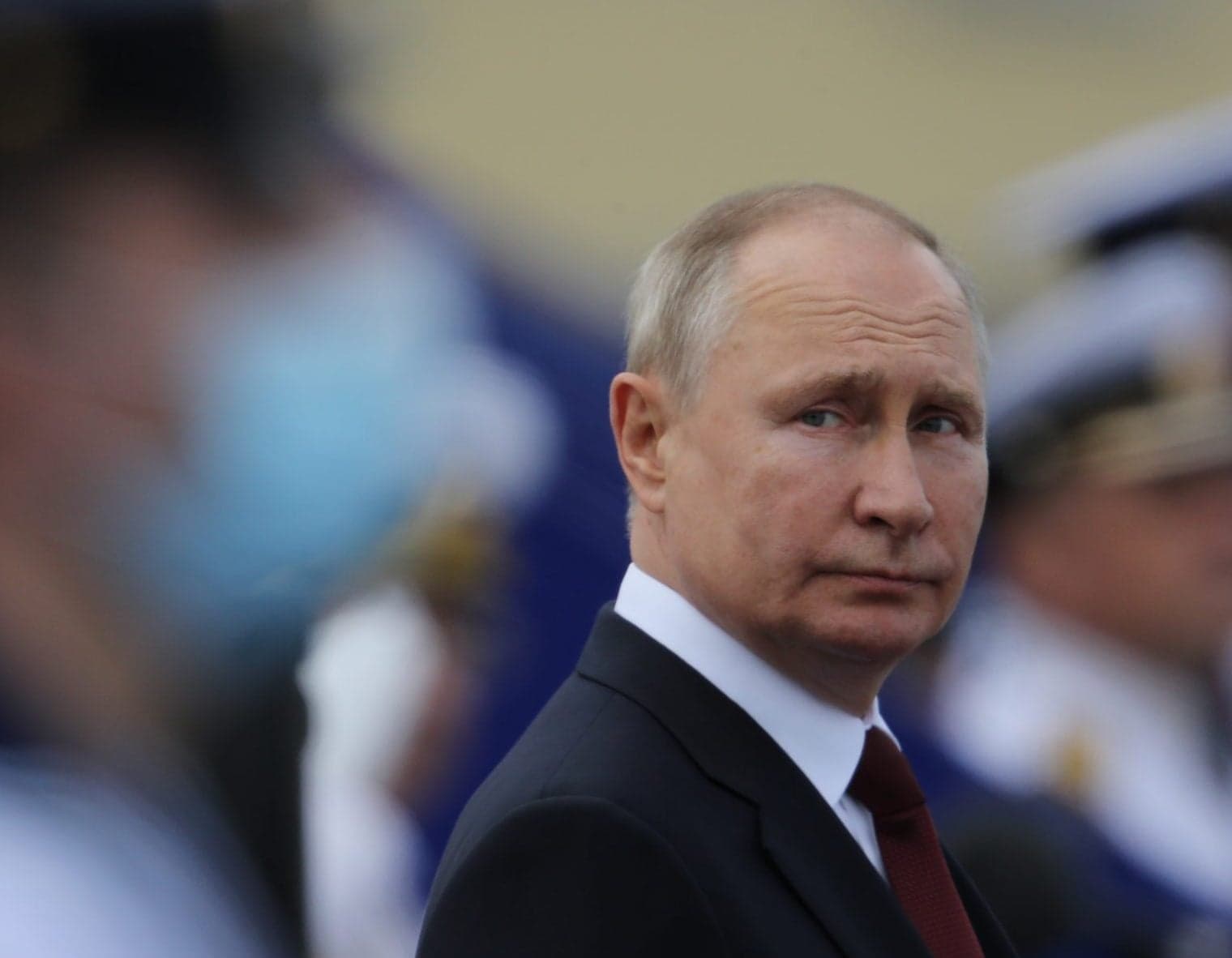
Has Putin used nuclear weapons before?
While any talk of nuclear weapons is cause for concern, it is worth remembering Putin has never used them. In fact, the only time in history that they've been used in combat is when the US used them against Japan in August 1945. The Soviet Union did, however, successfully test its first bomb in 1949.
But Putin still has plenty of atrocities to answer for, such as annexing Crimea, starting a war in the Donbas, and now, invading Ukraine.
On 4 February 2000, while Putin was serving as Russia's acting president, Russian forces devastated the village of Katyr Yurt in the Chechen-Russian conflict despite it being a safe zone for refugees. It is considered one of the most savage atrocities since WW2. Putin even bombed buses brought in to ship civilians out.
Local witnesses told
The Guardian they counted at least 363 corpses of people from the village - piled two or three high in the street before Russian troops dumped them in a mass grave.
Putin consistently denied human rights abuses in Chechnya and the following month he was voted the official president of Russia.
What weapons is Putin already using in Ukraine?
Russian troops are already using some of their most devastating weapons in Ukraine.
Footage captured by CNN reporters showed a TOS-1 heavy flamethrower being transported to the Ukrainian border on Saturday.
https://twitter.com/fpleitgenCNN/status/1497519335350452231?s=20&t=SAfQDyJWMjzOryRfXxKpQw
It is one of the most feared weapons systems in Russia's conventional armoury and fires thermobaric rockets by using surrounding oxygen to create high-temperature explosions.
Russian forces have already used the BM-21 “Grad” multiple launch rocket system during the invasion. These have 40 launching tubes for 122mm rockets.
https://twitter.com/BNONews/status/1496738880749727755?ref_src=twsrc%5Etfw%7Ctwcamp%5Etweetembed%7Ctwterm%5E1496738880749727755%7Ctwgr%5E%7Ctwcon%5Es1_&ref_url=https%3A%2F%2Fwww.joe.co.uk%2Fnews%2F319168-319168
Terrifying footage which circulated social media last week showed
missiles raining down on Ukrainian cities - with one appearing to crash into a Ukrainian airport which then burst into flames.
Agnès Callamard, Amnesty International’s secretary-general, told
The Guardian that the Russian military has shown a "blatant disregard for civilian lives by using ballistic missiles and other explosive weapons with wide-area effects in densely populated areas".
Russia's use of weapons such as the T-72 tank, BMP3 armed fighting vehicles, Mi8 and Ka-52 helicopters in Ukraine is considered conventional.
Kalibrs, which can travel over 1,500 miles before impact and can be fired from ships, aircraft, and submarines, have also reportedly been used.
What kind of arsenal has Putin got?
As of early this year, Russia has approximately 5,977 nuclear warheads in its arsenal, according to the
Federation of American Scientists. Around 1,500 of these are retired (but still largely intact) warheads that are waited to be dismantled.
Russia has not signed the Treaty on the Prohibition of Nuclear Weapons.
The UK has just 225. Ukraine was persuaded to give up its nuclear warheads after the 1994 Budapest Memorandum, after the US, Russia, and Britain said they would refrain from attacking the nation. The US has the second most nuclear warheads, with 5,550. Combined, the two countries, have 90 per cent of the world’s nuclear warheads.
A single nuclear warhead can kill hundreds of thousands of people.
How quickly could they be fired?
Former British Army chemical and nuclear weapons expert, and author of Chemical Warrior, Hamish de Bretton-Gordon, told
The Mirror that "Once the order is given, it will take minutes rather than hours to get them ready, and 20-30 minutes flight time to target."
Russian missiles would target a number of UK sites, according to Professor Anthony Glees, a security expert from the University of Buckingham. Putin would do this in a bid to wipe out the British government and prevent any retaliation.
"A single Russian nuke would wipe out the whole of London," Prof Glees said, "It would be the end of life as we know it.”
On a more optimistic note, Professor de Bretton-Gordon said the West will be working in a number of ways to ensure missiles don't take off.
He said: “This is what the whole spy network and Special Forces like the SAS is all about, and there will be Russian spies trying to do the same.”
Related stories: