









News

Share
Published 16:27 12 Oct 2025 BST
Updated 16:27 12 Oct 2025 BST
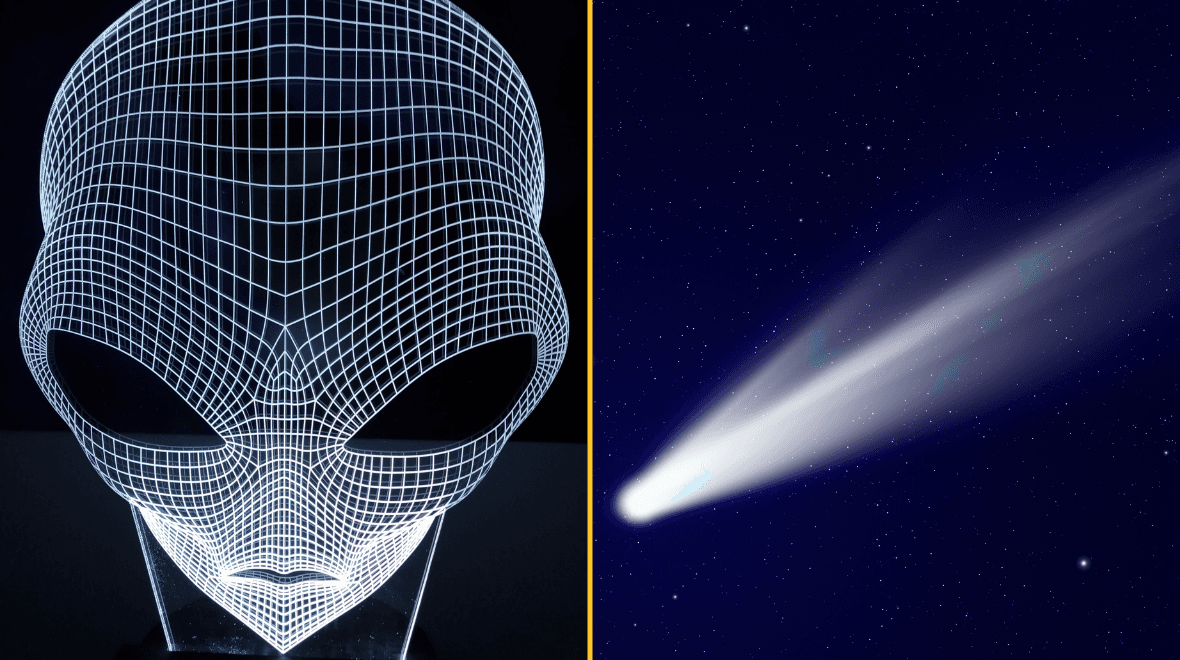
Since its discovery in July, Professor Avi Loeb has been closely tracking the interstellar object known as 3I/ATLAS.
He’s raised the possibility that this visitor speeding toward Earth might not be a simple comet but rather a disguised piece of alien technology — a kind of ‘Trojan Horse’.
Loeb estimates there’s a 30 to 40 percent chance the object isn’t naturally occurring, though he acknowledges that this assessment could change as new information becomes available.
The object is set to pass extremely close to Earth in December, coming within just 167 miles, which offers a rare opportunity for detailed observation.
“We have very limited knowledge about how many extraterrestrial probes might be passing through our Solar System,” Loeb commented on his blog.
“With so much uncertainty, it’s important to gather as much data as possible from all directions to better understand any potential risks.”
Images recently captured by NASA’s rover on Mars showed 3I/ATLAS glowing green with a long, cylindrical shape, sparking fresh debate about its true nature. Loeb, however, suggests this elongated appearance could be a trick caused by the rover’s camera stacking multiple images over time, making a round object look stretched out.
He estimates the object is likely rounder and still enormous—potentially over 28 miles across.
In contrast, Dr Horace Drew, a retired senior scientist from Australia’s CSIRO, proposed that the green glow might indicate an interstellar spacecraft coated with nickel.
“The images reveal an extended white core surrounded by a green halo—not simply a small white sphere,” Drew said.
Adding to this, telescope data highlighted by Loeb detected a plume of nickel from 3I/ATLAS without the usual accompanying iron found in natural comets.
This unusual signature points to a possible industrial origin.
“Could this be another hint towards 3I/ATLAS having an artificial, technological source?” Loeb questioned.
“The chemical process behind the nickel emissions—nickel carbonyl formation—is incredibly rare in natural comets but commonly used in industrial nickel refining.”
Supporting these findings, a recent Chilean study measured 3I/ATLAS releasing nickel and cyanide at increasing rates as it approaches the sun.
Scientists noted that these emissions don’t align with typical comet behaviour and may result from sunlight breaking down nickel-containing dust.

News

News

News

News
Government plans to expand BBC licence fee with proposed ‘YouTube Tax’
YouTube, Netflix and Disney+ could face new BBC fee rules Watching videos online could soon come with an unexpected cost, as the government considers extending the BBC licence fee to streaming services and digital platforms. The proposed shake-up could bring websites and services such as YouTube, Netflix, Amazon Prime Video and Disney+ under the same […]
News
1 day ago
19 people injured after Channel Tunnel collision between bus and train
The incident happened on the French side of the tunnel. A collision between a bus and a train on the French side of the Channel Tunnel has left 19 people injured. Latest reports from outlets in France say that a minibus transporting passengers hit a stationary train wagon in the loading area at the entrance […]
News
1 day ago
Former DUP leader Jeffrey Donaldson sentenced to 15 years in prison for child sex crimes
News